The final lecture in ECO 108!!! A lot of this lecture was spent discussing the potential profits of an entrepreneur.
Profits = Total revenues - Total costs
- total costs: explicit (accounting profits) and implicit (economic profits)
If Rachel decides to start a pizza business, what does she gain and what does she give up?
- she previously had a $30K and owned a building that rents for $6K
- savings acct. of $23,000 at 10% interest
- start business.... quits job, uses building, cashes out savings and borrows $20K
- Profits = Total revenues - Total costs
-> revenues = $85,000
-> Costs:
* explicit = -23,000 - 20,000 - (2,000)
* implicit = -6,000 - 30,000 - (2,300) .... opportunity costs
- Economic Profit = $1,700
Economic Profits
- if economic profit > $0, should do it
- how much better you are being an entrepreneur
- your services more valuable to society than other things
- only exist if there's uncertainty
Capitalism
- positive profits means you're doing something right
- negative profits means you should switch what you're doing --> incnetivizes people to do something else that's actually beneficial to society
Monday, December 12, 2011

Sunday, December 11, 2011
EWOT Goggles - 12/11
So we discussed in class this week the "life and adventures" of an entrepreneur. And I've come to conclude that these are the ballsiest people in the world. Why? The spectrum of success and failure for pretty much all other jobs is relatively small: you can either do well in the job and make your wages, or you can get fired and find another job that pays, even if a little less. But for entrepreneurs, sometimes it can be as close to life and death as you can possibly get. The amount of costs, both monetary and non-monetary, that entrepreneurs endure to start their business venture is an extremely large amount. Success can mean an eventual earnings total in the millions or perhaps billions. Failure means you're not only out of all that money, but all the other possible endeavors you could've embarked on plus all the time that was lost. Becoming an entrepreneur means you're taking a massive risk and for this reason, entrepreneurs have more balls than anyone.
Reading Analysis - 12/11
A.) The piece I chose to read was the Sumptuary Manifesto. The whole piece, written by an anonymous source who supports the "Peerless leader," is a drastic attack on consumerism. Taxes, tariffs, and other prohibitive restrictions are laid out in huge numbers so as to reduce the material spending of the society. It's everyone's "social responsibility" to abide by these laws which serve the ultimate purpose of removing material consumerism. These people obviously have not been taught any level of basic economics. There are so many things wrong this it's hard to find a place to begin. First of all, price ceilings are a staple point in the laws because "to allow markets to go uncontrolled would be to 'ascribe a magical automatism to the price system'" (p. 122). Markets have a way of correcting themselves; they have a built-in feedback system called prices. Obviously these people don't understand that. Also, the laws talk about a big international tariff in order to keep the valuable resources that poorer countries have within the country. This is also laughable because production and exchange is the way countries get richer; self-sufficiency is the road to poverty and preventing trade with other countries only makes them poorer, or at least prevents them from getting richer. Finally, all these restrictions on material consumption such as restrictions on buying alcohol, clothes, food, etc. could all be avoided if you just allowed the price system to act. Prices will rise and fall accordingly and material goods that were once easy to purchase become more expensive and therefore people have less incentive to buy them. All this adds up to a pretty hilarious idea that was ACTUALLY CONSIDERED!! That, in my opinion, is the most hilarious point of all.
B.) What's so wrong with material consumerism to begin with? Is this just one big attack on capitalism?
Doesn't it take up more resources to enforce all these laws?
What do you think will happen in the end as a result of these regulations?
C.) This short, 4-page article actually does a good job of summing up a lot of things we've learned in Economics so far, especially regarding markets, self-sufficiency and price ceilings. There are obviously a lot of things wrong with this excerpt economically and identifying them helps to reinforce what we have learned in the class.
B.) What's so wrong with material consumerism to begin with? Is this just one big attack on capitalism?
Doesn't it take up more resources to enforce all these laws?
What do you think will happen in the end as a result of these regulations?
C.) This short, 4-page article actually does a good job of summing up a lot of things we've learned in Economics so far, especially regarding markets, self-sufficiency and price ceilings. There are obviously a lot of things wrong with this excerpt economically and identifying them helps to reinforce what we have learned in the class.
Friday, December 9, 2011
Class Lecture #41 - 12/9
- would professionals and employees really work their absolute hardest and devote so much time and energy into something that they were doing for free? --> $$ incentivizes them, only makes them more productive
Entrepreneurs: Figure out what people value and make those products
Three Factors of production:
1. Land - explicit cost is the rent and implicit cost is the opportunity cost of paying that rent
2. Labor - explicit cost is the wage and implicit cost is the opp. cost of that wage
3. Capital - explicit cost is rent and implicit cost is opp. cost of rent
Entrepreneurial Equation
Profitability Rate = Rental rate + Appreciation rate - Interest rate
Rental rate = (annual rent)/price
Entrepreneurs: Figure out what people value and make those products
Three Factors of production:
1. Land - explicit cost is the rent and implicit cost is the opportunity cost of paying that rent
2. Labor - explicit cost is the wage and implicit cost is the opp. cost of that wage
3. Capital - explicit cost is rent and implicit cost is opp. cost of rent
Entrepreneurial Equation
Profitability Rate = Rental rate + Appreciation rate - Interest rate
Rental rate = (annual rent)/price
Wednesday, December 7, 2011
Class Lecture #40 - 12/7
Tax Incidence: Sales Tax
- if we draw out the supply/demand curve before and after the tax, we see that the same exact economic burden exists for buyers and sellers as it did for the excise tax
* completely independent
- the demand curve is steep --> inelastic, so less sensitive to price changes
- the supply curve is flat --> elastic, so more sensitive to price changes
- more efficient to tax the demanders and put the majority of the economic burden on them
Taxes
- taxes cause people to look for substitutes
- cost of taxes are the opportunity costs and the dead weight loss
- not to mention there's a cost to sustain the IRS and the tax industry
- all this adds up to a very inefficient way of taxing --> need more efficient way
- if we draw out the supply/demand curve before and after the tax, we see that the same exact economic burden exists for buyers and sellers as it did for the excise tax
* completely independent
- the demand curve is steep --> inelastic, so less sensitive to price changes
- the supply curve is flat --> elastic, so more sensitive to price changes
- more efficient to tax the demanders and put the majority of the economic burden on them
Taxes
- taxes cause people to look for substitutes
- cost of taxes are the opportunity costs and the dead weight loss
- not to mention there's a cost to sustain the IRS and the tax industry
- all this adds up to a very inefficient way of taxing --> need more efficient way
Monday, December 5, 2011
Class Lecture #39 - 12/5
Does making drugs illegal solve the drug problem?
- becomes costly to hire extra law enforcement to monitor the drug trade --> lose out on other services possible with that extra money spent (opp. cost)
- more enforcement raises tension and results in more violent acts as a result
Tax Incidence: Excise Tax
- tax on sellers
- the initial EQ point for bubble gum yields a price of $3.00 and a quantity of 3 million
- an excise tax of $1.00 produces:
Pbuyers = $3.75
Psellers = $2.75
QT = 2.75 million
- when we do out the math, we see that the net economic burden for the buyers (75 cents) is greater than that of the sellers (25 cents), even though an excise tax is supposed to be a tax on sellers
- the tax also produces a dead weight loss
* the world is poorer by that amount
* represents the possible transactions that would've happened had the tax not been in place
- becomes costly to hire extra law enforcement to monitor the drug trade --> lose out on other services possible with that extra money spent (opp. cost)
- more enforcement raises tension and results in more violent acts as a result
Tax Incidence: Excise Tax
- tax on sellers
- the initial EQ point for bubble gum yields a price of $3.00 and a quantity of 3 million
- an excise tax of $1.00 produces:
Pbuyers = $3.75
Psellers = $2.75
QT = 2.75 million
- when we do out the math, we see that the net economic burden for the buyers (75 cents) is greater than that of the sellers (25 cents), even though an excise tax is supposed to be a tax on sellers
- the tax also produces a dead weight loss
* the world is poorer by that amount
* represents the possible transactions that would've happened had the tax not been in place
Sunday, December 4, 2011
EWOT Goggles - 12/4
Our futon broke! This sucks because now we have this piece of (essentially) junk in the middle of our room. It seems easy to fix: just pick up some screws and bolts from ACE and fix the damn thing. But, as college students, the opportunity cost of going to the store to actually pick them up and then to later reassemble the thing is exponentially high. Whether we like it or not, there are so many other things that we'd rather be doing that going to the store is like going to war or something. Not to mention, we're mad poor and while the monetary cost is extremely low and insignificant, the combination of that and the non-monetary costs creates a blockade of cost that we'd rather not endure. If only we could magically summon the bolts and have a guy fix the futon for us. I'll look into it....
Reading Analysis - 12/4
A.) I find it interesting that a golf course can generate such strong effects on a supply-demand curve. I'm a golfer myself, so I know the whole ordeal to get a good tee time at a good course. But I've never experienced anything like this: a course where the demand HUGELY outweighs the supply, enough so that a second market evolves within the first market to get on Bethpage Black. Without the NY golf shuttle, the price of playing a round of 18 is close to $100, a bargain based on the reputation of the course. Due to this fact and the fact that the course resides in Long Island, one of the most densely populated areas in the U.S, the demand to play one round of golf is incredibly high. So high that we actually start to see lines form just to get on the course that day. But the shuttle introduces a much different effect on peoples' behaviors. The shuttle charges $800, a price close to 2 times the prices of some of the most expensive public courses in the country, just to arrange a tee time. Even though the company has rigged the system to an extent, an individual is still not guaranteed a tee time when they want one. Also, people who choose to use the NY golf shuttle endure additional non-monetary costs for the time and effort they spend trying to "sneak around" and avoid the regulations set by the course. The course does not like the idea of people paying 8 times as much money to get onto the same course, but the shuttle adapted to the course's regulations and still the problem exists. Whether the course likes it or not, the NY Golf Shuttle is really the only way for people to get onto the course and this should continue until the prosecution actually finds something that can bring the company down.
B.) Is the shuttle even bad? It does, after all, lower demand and more people who want to play can play.
Why does the course have a problem with the Shuttle?
How much are the non-monetary costs really greater when people choose to not use the Shuttle?
C.) This reading was assigned because it demonstrates the effects of the introduction of a second market on individuals' behaviors. It demonstrates that as prices go up steeply, the demand to play does go down. However, the behaviors of the demanders is overall fairly inelastic because people still fight to get on the course even though it costs 8 times as much to play there.
B.) Is the shuttle even bad? It does, after all, lower demand and more people who want to play can play.
Why does the course have a problem with the Shuttle?
How much are the non-monetary costs really greater when people choose to not use the Shuttle?
C.) This reading was assigned because it demonstrates the effects of the introduction of a second market on individuals' behaviors. It demonstrates that as prices go up steeply, the demand to play does go down. However, the behaviors of the demanders is overall fairly inelastic because people still fight to get on the course even though it costs 8 times as much to play there.
Friday, December 2, 2011
Class Lecture #38 - 12/2
Price Floors:
- Most common price floor = minimum wage
- When you set a price (or wage) floor,
* Quantity demand for employers goes down because firms don't want to hire as many workers
* Quantity supply for employers goes up because more workers want to make more $
- As a result of all this, a surplus of workers develops and this causes higher rates of unemployment
- Is there a better way to pay workers --> E.I.T.C. (Earned Income Tax Credit)
Illegal Drugs
- making them illegal means you keep the same point (price) of equilibrium, but the supply curve becomes steeper because it costs more to supply these drugs
- As a result, the people who handle drug transactions are only those who know what they're doing
- Most common price floor = minimum wage
- When you set a price (or wage) floor,
* Quantity demand for employers goes down because firms don't want to hire as many workers
* Quantity supply for employers goes up because more workers want to make more $
- As a result of all this, a surplus of workers develops and this causes higher rates of unemployment
- Is there a better way to pay workers --> E.I.T.C. (Earned Income Tax Credit)
Illegal Drugs
- making them illegal means you keep the same point (price) of equilibrium, but the supply curve becomes steeper because it costs more to supply these drugs
- As a result, the people who handle drug transactions are only those who know what they're doing
Wednesday, November 30, 2011
Class Lecture #37 - 11/30
The Economics of Price Controls: Price Ceilings
- By setting a price ceiling, there are more apartments that people want than there actually are --> SHORTAGE
- At Market Equilibrium:
> P = $1,000 Q = 12,000
- At "Controlled" Equilibrium:
> P = $800 QD = 14,000 QS = 10,000
> 4,000 shortage
> Not market clearing
- Major Outcomes of Price Ceilings:
1. Reduced availability
2. Lower quality
3. Black markets
4. Misallocations
5. Other Neighborhoods
6. Fairness
7. Discrimination
8.
- By setting a price ceiling, there are more apartments that people want than there actually are --> SHORTAGE
- At Market Equilibrium:
> P = $1,000 Q = 12,000
- At "Controlled" Equilibrium:
> P = $800 QD = 14,000 QS = 10,000
> 4,000 shortage
> Not market clearing
- Major Outcomes of Price Ceilings:
1. Reduced availability
2. Lower quality
3. Black markets
4. Misallocations
5. Other Neighborhoods
6. Fairness
7. Discrimination
8.
Monday, November 28, 2011
Class Lecture #36 - 11/28
Properties of Market Equilibrium
- Imagine a stylized market with 5 buyers and 5 sellers:
- point on demand curve = marginal value
- point on supply curve = marginal opportunity cost
- The best suppliers are the ones who can for the lowest cost (s1, s2, s3)
- if s4 or s5 produces --> greater cost of next best opportunity ($25/30 that could go into making something else) ..... society loses >$10 of production
- The above situation occurs if central planning determined who produced guitars..... Decentralize decision-making!
Sunday, November 27, 2011
EWOT Goggles - 11/27
So virtually every family in America who can afford it celebrates Thanksgiving by buying a turkey. Is there ever a shortage in turkeys because of the high demand? What kind of price changes do turkey consumers experience at this time of year? What kind of market exists for turkeys on the days following Thanksgiving? There are still turkey sales after Thanksgiving but they're obviously reduced significantly. It always seems as if a family needs to get a turkey, they can somewhere. So the supply must be reasonably high during this time of year. I'm sure this happens with other products that experience mass purchases at one time during the year and hardly any at any other time (ex: Christmas trees, pumpkins, etc.).
Friday, November 25, 2011
Reading Analysis - 11/25
A.) For this week's reading assignment, I chose to read the blog by Mike Munger regarding the room draw for undergraduate students at Duke University. What I don't understand is why it is wrong to introduce money to a transaction. Based on what the Head of Residential Life was saying, paying someone for a house is not only against the rules, it's also immoral and the parties involved are heavily punished. But the trade was fine at first until money was added to the exchange. The money doesn't really add an extra dimension; both groups are still happy with the exchange and receive more value from their new houses. Maybe the Duke administrators are pissed off at the fact that an exchange is happening that doesn't result in a sum of money received by the university. It's not like illegal substances or houses are being exchanged. So what could possibly be the problem. Maybe this is just a result of a lottery trying to ration goods instead of prices. But according to Duke, the price system is immoral under these circumstances, so I guess it's almost impossible for people to benefit from the room draw.
B.) What is immoral about paying for another house?
If the price was significantly lower, would the university's response be any different?
Why was the lottery used in the first place?
C.) This reading was assigned to demonstrate the effects of a rationing mechanism other than the price system. It also brings to light the problems with America today: a failure to understand simple economics leads to unnecessary problems.
B.) What is immoral about paying for another house?
If the price was significantly lower, would the university's response be any different?
Why was the lottery used in the first place?
C.) This reading was assigned to demonstrate the effects of a rationing mechanism other than the price system. It also brings to light the problems with America today: a failure to understand simple economics leads to unnecessary problems.
Class Lecture #35 - 11/23
This class lecture talked about the disadvantage of having a "higher power" that controls economic activity and how the price system solves the problem....
- Decentralized >> Centralized economy
- For a flatter supply curve, a small change in price results in a big change in quantity supplied
* Ex: titanium..... if the price of titanium rises a little, a lot more effort will go into digging it up if it's easy to dig up titanium (if not, then the curve is steeper)
- A czar of titanium would need to know a whole lot to account for this change in price and to produce the appropriate response
- The market solves this problem by steering the efforts to dig up the titanium towards the right professions who know how to do it because of substitutes in the market
- Decentralized >> Centralized economy
- For a flatter supply curve, a small change in price results in a big change in quantity supplied
* Ex: titanium..... if the price of titanium rises a little, a lot more effort will go into digging it up if it's easy to dig up titanium (if not, then the curve is steeper)
- A czar of titanium would need to know a whole lot to account for this change in price and to produce the appropriate response
- The market solves this problem by steering the efforts to dig up the titanium towards the right professions who know how to do it because of substitutes in the market
Tuesday, November 22, 2011
Class Lecture #34 - 11/21
This lecture talked about equilibrium and the price system...

Two questions that are always asked:
1. How is each side (buyers and sellers) of market affected by a point on the curve?
2. Whose plans are satisfied?
Consider two points on the curve:
- Price below the equilibrium point....
* low price = high demand, low supply..... shortage at that price
* suppliers are satisfied because there are more than enough buyers to purchase their goods at that price
- Price above the equilibrium point.....
* high price = low demand, high supply...... surplus at that price
* demanders are satisfied because there are more than enough sellers to buy from
The point where the supply curve meets the demand curve is the equilibrium point.... always strive for this point (neither group has incentive to change behavior)
Price system
- $$ lowers cost of engaging in a transaction
- Double coincidence of wants = don't have $ --> need to find someone who produces a good of value that also wants your good (bartering sucks!)
- if don't have $, hard to trade because you can't divide up goods (ex: guitar)
Two questions that are always asked:
1. How is each side (buyers and sellers) of market affected by a point on the curve?
2. Whose plans are satisfied?
Consider two points on the curve:
- Price below the equilibrium point....
* low price = high demand, low supply..... shortage at that price
* suppliers are satisfied because there are more than enough buyers to purchase their goods at that price
- Price above the equilibrium point.....
* high price = low demand, high supply...... surplus at that price
* demanders are satisfied because there are more than enough sellers to buy from
The point where the supply curve meets the demand curve is the equilibrium point.... always strive for this point (neither group has incentive to change behavior)
Price system
- $$ lowers cost of engaging in a transaction
- Double coincidence of wants = don't have $ --> need to find someone who produces a good of value that also wants your good (bartering sucks!)
- if don't have $, hard to trade because you can't divide up goods (ex: guitar)
Sunday, November 20, 2011
EWOT Goggles - 11/20
I've been going to the gym a lot lately to lift. As a result, I've been eating a lot more food and taking in a lot more calories. What does this do to my wallet? Well, obviously I'm spending more but since I'm using declining, does that have an effect. YES! Since all my declining has already been paid for, buying more food doesn't change the amount of money I'm spending. Therefore, it's a sunk cost and only my marginal cost increases due to the fact that my declining balance goes down. So, unless I go over the declining limit, I'm not spending any more money (more or less) on food.
Reading Analysis - 11/20
This week's reading assignment consisted of 4 propaganda images that sent messages to the American public about WW2, slaves, and the economy. When looking at the images in the context of supply and demand, we can say that:
1.) For the first image, the demand for (war) resources is obviously very high and so the image associates wasting resources to essentially aiding the opposition. Based on the message the image is sending, the supply is relatively low, so the prices for these resources are likely low as well.
2.) Virtually the same message is seen in the second piece of propaganda. The picture suggests that by driving your car alone, you are riding with Hitler, or, you're "teaming up" with Hitler. The message here is to conserve gasoline and materials to make cars by sharing cars, so it's assumed that the demand for these resources is again very high and the supply is low.
3.) The third image consists of a slave family that is being whipped or at least abused by their slave master. The family is shown in the light while the slave master is shown in the dark, specifically inside a cast shadow that shows a picture of someone holding a whip. The slave family is in a position of helplessness and the slave master in a position of power. The propaganda wants a change in society where no slaves exist and everyone is free. The demand for freedom is high but the supply is low and since a change is favorable it is a shift towards a higher supply and lower demand of freedom.
4.) The fourth image shows a picture of a woman who makes a pledge to only pay for goods that are reasonably priced and to stop settling for rationed goods. The demand curve has experienced a shift to the right as the prices are higher than they were before for the same quantity demanded. The hope for the U.S. Dept. of Economic Stabilization is to get back to the point where the quantity demanded is at a lower price (shift back to the left). The same goes for the supply curve except the shift occurs in the opposite direction.
B.) What determines whether a propaganda poster is effective or not other than the response it administers?
What events do you think would produce the biggest shift in the supply/demand curve?
What was the process of coming up with a propaganda image like?
C.) This assignment was assigned because it is an application of the theories of supply and demand in the U.S. economy, particularly during times of hardship. The images demonstrate the dramatic effects that these events had on supply and demand.
1.) For the first image, the demand for (war) resources is obviously very high and so the image associates wasting resources to essentially aiding the opposition. Based on the message the image is sending, the supply is relatively low, so the prices for these resources are likely low as well.
2.) Virtually the same message is seen in the second piece of propaganda. The picture suggests that by driving your car alone, you are riding with Hitler, or, you're "teaming up" with Hitler. The message here is to conserve gasoline and materials to make cars by sharing cars, so it's assumed that the demand for these resources is again very high and the supply is low.
3.) The third image consists of a slave family that is being whipped or at least abused by their slave master. The family is shown in the light while the slave master is shown in the dark, specifically inside a cast shadow that shows a picture of someone holding a whip. The slave family is in a position of helplessness and the slave master in a position of power. The propaganda wants a change in society where no slaves exist and everyone is free. The demand for freedom is high but the supply is low and since a change is favorable it is a shift towards a higher supply and lower demand of freedom.
4.) The fourth image shows a picture of a woman who makes a pledge to only pay for goods that are reasonably priced and to stop settling for rationed goods. The demand curve has experienced a shift to the right as the prices are higher than they were before for the same quantity demanded. The hope for the U.S. Dept. of Economic Stabilization is to get back to the point where the quantity demanded is at a lower price (shift back to the left). The same goes for the supply curve except the shift occurs in the opposite direction.
B.) What determines whether a propaganda poster is effective or not other than the response it administers?
What events do you think would produce the biggest shift in the supply/demand curve?
What was the process of coming up with a propaganda image like?
C.) This assignment was assigned because it is an application of the theories of supply and demand in the U.S. economy, particularly during times of hardship. The images demonstrate the dramatic effects that these events had on supply and demand.
Saturday, November 19, 2011
Class Lecture #33 - 11/18
- As seen in the last class lecture, the price system is the only rationing mechanism that provides constructive competition and therefore proves to be effective.
- When you ration by prices, you allow people to decide for themselves.
- Prices force tradeoffs.... when the price of water goes up, people start to use water on the things they value the most. --> values fluctutate
- Price goes up = incentive to conserve
- Health care
- Is it possible to make access to health care independent from income?
- Does it matter?
Wednesday, November 16, 2011
Class Lecture #32 - 11/16
Challenge.... scarcity = not enough stuff to go around. How do we ration goods and resources?
Types of Rationing Mechanisms:
- Need - Equal Shares
- Queues (waiting in line) - Kicking ass
- Lottery - Merit (beauty? smarts?)
All of the above methods prove to be flawed and they don't allocate resources based on where they should be. Examples:
Queues = length of line is price
Lottery = people who value the good more don't necessarily get it
Kickin ass = impossible to predict/plan for anything
Merit = how do you measure merit?
Further Evaluation of Rationing Mechanisms: Where does competition come from? --> Scarcity
(1) Is the competition between individuals constructive or destructive?
- all of the above examples prove to be destructive. What can we use that yields constructive competition?...
(2) How does the mechanism impact supply?.... must be able to produce in future
(3) Other considerations
What is the solution.....
PRICE SYSTEM
Types of Rationing Mechanisms:
- Need - Equal Shares
- Queues (waiting in line) - Kicking ass
- Lottery - Merit (beauty? smarts?)
All of the above methods prove to be flawed and they don't allocate resources based on where they should be. Examples:
Queues = length of line is price
Lottery = people who value the good more don't necessarily get it
Kickin ass = impossible to predict/plan for anything
Merit = how do you measure merit?
Further Evaluation of Rationing Mechanisms: Where does competition come from? --> Scarcity
(1) Is the competition between individuals constructive or destructive?
- all of the above examples prove to be destructive. What can we use that yields constructive competition?...
(2) How does the mechanism impact supply?.... must be able to produce in future
(3) Other considerations
What is the solution.....
PRICE SYSTEM
Monday, November 14, 2011
Class Lecture #31 - 11/14
This class introduced the theory of supply....
"Law" of supply = when the price goes up, the quantity supplied goes up (i.e it costs more to make more)
- quantity supplied = how much you want to produce at any particular price
SUPPLY SCHEDULE
- price goes up --> willing to make more
What changes supply?
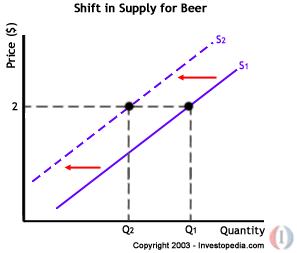 1.) own price (Qs) = move along the supply curve
2.) something else = supply curve shifts
- What shifts supply curve?...
* change in factor prices
* technology changes
* substitutes
* expectations
Supply elasticities
n = (% change in Qs)/(% change in price)
> 1 elastic
< 1 inelastic
What you can read off curve:
(1) marginal opp. cost
(2) total costs
(3) total revenues
(4) producer surplus
"Law" of supply = when the price goes up, the quantity supplied goes up (i.e it costs more to make more)
- quantity supplied = how much you want to produce at any particular price
SUPPLY SCHEDULE
|
Price/M.O.C. (marginal opportunity cost)
|
Quantity Supplied
|
|
$0
|
0
|
|
$0.50
|
0
|
|
$1.00
|
1
|
|
$1.50
|
2
|
|
$2.00
|
3
|
|
$2.50
|
4
|
|
$3.00
|
5
|
- price goes up --> willing to make more
What changes supply?
1.) own price (Qs) = move along the supply curve2.) something else = supply curve shifts
- What shifts supply curve?...
* change in factor prices
* technology changes
* substitutes
* expectations
Supply elasticities
n = (% change in Qs)/(% change in price)
> 1 elastic
< 1 inelastic
What you can read off curve:
(1) marginal opp. cost
(2) total costs
(3) total revenues
(4) producer surplus
Saturday, November 12, 2011
Class Lecture #30 - 11/11
Elasticity and Total Revenues
Total Revenues = P * Q
- when price goes up, Q goes down
- when price goes down, Q goes up
- Example: P goes from $50 - $80 and Q goes from 10 - 4..... is it elastic?
* TRA = $50 x 10 = $500
* TRB = $80 x 4 = $320 ...... decrease in total revenue = price change and TR change in opposite directions = ELASTIC
Income Elasticity of Demand
- (% change in Q)/(% change in income) ......
* > 0 = normal good
* < 0 = inferior good
We also began very preliminary discussions on the law of supply....
Total Revenues = P * Q
- when price goes up, Q goes down
- when price goes down, Q goes up
- Example: P goes from $50 - $80 and Q goes from 10 - 4..... is it elastic?
* TRA = $50 x 10 = $500
* TRB = $80 x 4 = $320 ...... decrease in total revenue = price change and TR change in opposite directions = ELASTIC
Income Elasticity of Demand
- (% change in Q)/(% change in income) ......
* > 0 = normal good
* < 0 = inferior good
We also began very preliminary discussions on the law of supply....
Class Lecture #29 - 11/9
Elasticity (sensitivity: how responsive we are to changes)
n = (% change in Quantity Demanded)/(% change in own price)
- What impacts n?
(1) Time (2) Budgets (3) Substitutes
1) Time: long run = elasticity higher, short run = elasticity lower
2) Budget: higher elasticity for things that make up a great % of budget
3) Substitutes: higher elasticity if more substitutes
n = (% change in Quantity Demanded)/(% change in own price)
- What impacts n?
(1) Time (2) Budgets (3) Substitutes
If n is: | Demand at that point is: | “Picture” | “Words” | Total Revenue Changes |
>1 | “elastic” | flat | sensitive | ΔTR moves in opp. Direction than ΔP |
= 1 | Unit elastic | X | X | X |
<1 | “inelastic” | steep | Not very sensitive | ΔTR same as ΔP |
1) Time: long run = elasticity higher, short run = elasticity lower
2) Budget: higher elasticity for things that make up a great % of budget
3) Substitutes: higher elasticity if more substitutes
Class Lecture #28 - 11/7
This lecture focused on demand curves and how they can shift to the left and right and how you can move up and down along a curve (quantity demand).
Demand: willingness and ability to consume
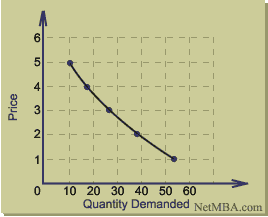
MARKET Demand
- As the prices decrease, the quantity demand increases and vice versa
= movement along curve
- The shape of a demand curve is different for every individual
- Is it possible to aggregate multiple curves into one super curve?
--> curve gets flatter as we aggregate further
--> hard to aggregate beyond a single good
Comparative Statics.... What changes people's consumption of a good?
- own price
- everything else:
1. Income 2. Substitutes 3. Expectations 4. Tastes 5. # of individuals
(income and substitutes = ability, expectations, tastes, # = willingness)
 Income (NOT PRICES!)
- Normal goods = income goes up, quantity demand goes up
- Inferior goods = income goes up, quantity demand goes down
preferences subjective for everyone
Prices of Other Goods
- Substitutes: Q moves in same direction as price change
- Complements: Q moves in opposite direction as price change
Demand: willingness and ability to consume
MARKET Demand
- As the prices decrease, the quantity demand increases and vice versa
= movement along curve
- The shape of a demand curve is different for every individual
- Is it possible to aggregate multiple curves into one super curve?
--> curve gets flatter as we aggregate further
--> hard to aggregate beyond a single good
Comparative Statics.... What changes people's consumption of a good?
- own price
- everything else:
1. Income 2. Substitutes 3. Expectations 4. Tastes 5. # of individuals
(income and substitutes = ability, expectations, tastes, # = willingness)
Income (NOT PRICES!)- Normal goods = income goes up, quantity demand goes up
- Inferior goods = income goes up, quantity demand goes down
preferences subjective for everyone
Prices of Other Goods
- Substitutes: Q moves in same direction as price change
- Complements: Q moves in opposite direction as price change
Sunday, November 6, 2011
Reading Analysis 11/6
A.) I thought it was interesting that everything in the economy as described by the author arose because of their "immediate needs and circumstances" (p. 190). Basically, everything came about because of a need in that particular sector. Even more amazing is the fact that no one orchestrated this movement towards the desired goal; it just came about as one would expect from a typical market. For example, prices for everything experienced inflation whenever more rations (of cigarettes) were delivered to the inmates. This excess in cigarettes caused the prices to rise substantially. But as a lot of these cigarettes began to disappear for non-monetary reasons, i.e. people who needed to smoke, prices experienced steady declines until the next truckload came in. It was clear that machine-made cigarettes were subject to this rising and falling of prices if used as currency, so a new currency was perhaps in the making. This coupled with the formation of a new restaurant introduced a new currency called the Bully Mark. But later when the camp was bombed, the value of cigarettes and food sharply increased, and thus the relative value of the BMk decreased. The cycle continues as more external disruptions are introduced and the economy adjusts accordingly. For this reason, we can say that the economy that arose in a POW camp is, at least in this way, the same as today's markets/economy.
B.) What makes the cigarette the most effective means of exchange in the camp?
What sorts of supplies did inmates have access to prior to the formation of the economy and how did their values change as a result of disruption?
How long did it take for the prices of certain items like bread to settle and how often did they fluctuate?
C.) This article was assigned to demonstrate the effects of the market system, even when no markets exist. It also demonstrates the effects of supply and demand and inflation on the price system.
B.) What makes the cigarette the most effective means of exchange in the camp?
What sorts of supplies did inmates have access to prior to the formation of the economy and how did their values change as a result of disruption?
How long did it take for the prices of certain items like bread to settle and how often did they fluctuate?
C.) This article was assigned to demonstrate the effects of the market system, even when no markets exist. It also demonstrates the effects of supply and demand and inflation on the price system.
EWOT Goggles - 11/6
This week in recitation, we talked about the illegitimacy of today's kidney transplant system and we identified poor trade techniques that directly contribute to this problem. For example, meddlesome preferences disallow any "underground" kidney exchanges to become standard protocol because of the so-called moral issues that are associated with it. Apparently people think it's wrong for fair and necessary exchanges to happen without the watchful eye from the government, even though if these same exchanges were made under today's system, they would be MUCH less efficient. So why doesn't this policy change? Why do people who are desperate for a new kidney have to wait years before they can actually get one when they can do the same thing faster and at a lower price when done "underground"? If we can buy food and other necessities today through markets, why can't we purchase a vital organ that will do the most important thing of all: sustain life (The Unbroken Window)?
Saturday, November 5, 2011
Class Lecture #27 - 11/4
Today's lecture was an introduction to supply and demand and we specifically talked about transaction costs and markets.
Transaction cost - cost of arranging and negotiating contracts and agreements. Three different types:
- "physical" = usually distance
- "ignorance" = not knowing other purchasing opportunities elsewhere
- Interference
A middleman's job is to get buyers and sellers together while also limiting as much as possible the transaction costs. They get a bad wrap because they don't actually produce anything, they just organize a transaction (sometimes poorly). Wegmans is a good example of a middle man because it reduces physical trans. costs by putting everything you need in one place, amongst other reasons.
Prices.... inform buyers and sellers on the value of something as well as its scarcity.
- MARKETS set prices
- many types of markets (goods, factor, etc.) and everything that applies to one market can apply to all other markets
Market - any collection of buyers and sellers (actual or potential).
- MARKETS --> prices emerge --> produce order.... what types of prices?
1. monetary 2. non-monetary 3. monetary AND non-monetary
Buyers = "Demanders" Sellers = "Suppliers"
- Goods - households - Goods - firms
- Factor - firms - Factor - households
Transaction cost - cost of arranging and negotiating contracts and agreements. Three different types:
- "physical" = usually distance
- "ignorance" = not knowing other purchasing opportunities elsewhere
- Interference
A middleman's job is to get buyers and sellers together while also limiting as much as possible the transaction costs. They get a bad wrap because they don't actually produce anything, they just organize a transaction (sometimes poorly). Wegmans is a good example of a middle man because it reduces physical trans. costs by putting everything you need in one place, amongst other reasons.
Prices.... inform buyers and sellers on the value of something as well as its scarcity.
- MARKETS set prices
- many types of markets (goods, factor, etc.) and everything that applies to one market can apply to all other markets
Market - any collection of buyers and sellers (actual or potential).
- MARKETS --> prices emerge --> produce order.... what types of prices?
1. monetary 2. non-monetary 3. monetary AND non-monetary
Buyers = "Demanders" Sellers = "Suppliers"
- Goods - households - Goods - firms
- Factor - firms - Factor - households
Thursday, November 3, 2011
Class Lecture #26 - 11/2
What happens to U.S. dollars when we trade with China? They have 4 options to choose from:
1. Send that money back by purchasing American goods
2. Invest in the American stock market (buy assets) because it's harder to do so in China. Our stock market is a very attractive option for foreigners based on the fact that our capital account balance has seen a surplus every year
3. Buy from a country other than the U.S. (either products or assets). Eventually, this money will make it's way back to the U.S.
4. Eat the $$ - What seems to be the most absurd option would actually help the U.S. the most because it would raise the value of the dollar and make everyone richer.
Even though we have a trade deficit from our current account balance, our capital account balance balances it all out and we end up having a net balance of zero (we always have to have an international trade balance of zero because of the 4 options described above).
None of these options hurt the U.S. In fact, they all help us, so how can one argue that trade with China is bad? There is NO EVIDENCE that trade with China and the trade deficit are bad.
1. Send that money back by purchasing American goods
2. Invest in the American stock market (buy assets) because it's harder to do so in China. Our stock market is a very attractive option for foreigners based on the fact that our capital account balance has seen a surplus every year
3. Buy from a country other than the U.S. (either products or assets). Eventually, this money will make it's way back to the U.S.
4. Eat the $$ - What seems to be the most absurd option would actually help the U.S. the most because it would raise the value of the dollar and make everyone richer.
Even though we have a trade deficit from our current account balance, our capital account balance balances it all out and we end up having a net balance of zero (we always have to have an international trade balance of zero because of the 4 options described above).
None of these options hurt the U.S. In fact, they all help us, so how can one argue that trade with China is bad? There is NO EVIDENCE that trade with China and the trade deficit are bad.
Sunday, October 30, 2011
EWOT Goggles - 10/30
This week for me was characterized by the number of naps I took in the middle of the day. I took at least one every day and one day I actually took 3. The naps seemed to help my focus, at least compared to what it was before the naps. So what if we instituted a policy that required people to take a certain amount of time out of their days to nap or do whatever? It could be similar to the siestas they take in Mexico. Would our productivity increase or stay the same? We would have less time to do our jobs but so would everyone, so we would all be on the same playing field. We would be more rested and thus our focus and concentration would improve. Would this translate to more economic output or would it just throw us and the rest of the world off? I say we try it out for a day or a week or something and see what happens. My prediction: we see happier, more well-rested workers and our output and therefore our GDP increases.
Reading Analysis - 10/30
A.) A common theme that appears in all 3 videos is that the everyday people working at lower wages at infrastructure jobs are undervalued and at the mercy of more powerful institutions (media, government, etc.). From these 3 videos, the one thing that stuck out to me was Mike Rowe's discussion of following your passion vs. reality. If everyone followed their dreams, how many jobs would exist today that have to do with castrating sheep and mining and farming maggots? Not very many. It was even evident in the video that those people who Rowe talked to working these lower-end jobs actually seemed happy (ex: whistling roadclearers). And then he asked them if this was their ideal dream job and they would just laugh. So the point is that these jobs that are frowned-upon/looked down upon by most are all the more necessary than high tech jobs and stockbrokers and the such. But their reputation suffers because they aren't viewed as the most ideal. But talking to the people who actually do the jobs, it's evident that they skillfully adjust to the point where they even begin to enjoy what they're doing. These "infrastructure" jobs are necessary for everyone's prosperity and something needs to be done about their recent decline. To start, it's definitely helpful that guys like Mike Rowe are bringing to light the situation and trying to educate the public about the goods in manual labor.
B.) What efforts are the government taking to protect these infrastructure jobs from near extinction? Why don't they pursue this issue more fervently?
Can we really afford to keep telling our kids to "follow their dreams" if all that's doing is moving the workforce away from skilled manual labor?
If the trend continues, what will happen to the balance of labor jobs and "glamour" jobs? How much longer until we can't actually sustain this imbalance any more?
C.) These 3 media outlets were assigned to bring to light the issue with the decline of infrastructure jobs and how without them, the mass production and distribution of new technologies is virtually impossible. These people unfairly get a bad wrap and while it is true that trade is always good and the recent improvement in living standards is absolutely a good thing, we need these jobs nonetheless to sustain today's lifestyle and provide more opportunities to progress.
B.) What efforts are the government taking to protect these infrastructure jobs from near extinction? Why don't they pursue this issue more fervently?
Can we really afford to keep telling our kids to "follow their dreams" if all that's doing is moving the workforce away from skilled manual labor?
If the trend continues, what will happen to the balance of labor jobs and "glamour" jobs? How much longer until we can't actually sustain this imbalance any more?
C.) These 3 media outlets were assigned to bring to light the issue with the decline of infrastructure jobs and how without them, the mass production and distribution of new technologies is virtually impossible. These people unfairly get a bad wrap and while it is true that trade is always good and the recent improvement in living standards is absolutely a good thing, we need these jobs nonetheless to sustain today's lifestyle and provide more opportunities to progress.
Class Lecture #24 - 10/28
1.) Empirical evidence that trade does not cause job loss..... Does the trade deficit cause maunfacturing job loss? NO! Because in the agricultural sector the share of jobs has also gone down while there has actually been a trade surplus. So both sectors have seen a decrease in the share of jobs even though one experienced a trade deficit and the other experienced a surplus.
2.) Why doesn't trade cause job loss? Because when you trade, 2 things happen:
- Imports are paid for with exports
- You get RICHER.... so more jobs
So when you add it up... net zero jobs + more jobs = MORE JOBS!
3.) Cheap foreign labor in China...Better than US?
(Wages/Marginal Product of Labor) for China vs. (Wages/Marginal Product of Labor) for U.S.
$8 per hr/4 shirt per hr = $2/shirt (China)
$20 per hr/20 shirts per hr = $1/shirt (US)
So the U.S. an absolute advantage in making shirts. But what about comparative advantage?
China: $8/unit U.S.: $0.50/unit
U.S. has an absolute AND comparative advantage in making shirts.
2.) Why doesn't trade cause job loss? Because when you trade, 2 things happen:
- Imports are paid for with exports
- You get RICHER.... so more jobs
So when you add it up... net zero jobs + more jobs = MORE JOBS!
3.) Cheap foreign labor in China...Better than US?
(Wages/Marginal Product of Labor) for China vs. (Wages/Marginal Product of Labor) for U.S.
$8 per hr/4 shirt per hr = $2/shirt (China)
$20 per hr/20 shirts per hr = $1/shirt (US)
So the U.S. an absolute advantage in making shirts. But what about comparative advantage?
China: $8/unit U.S.: $0.50/unit
U.S. has an absolute AND comparative advantage in making shirts.
Wednesday, October 26, 2011
Class Lecture #23 - 10/26
1.) Some people who argue that trade is bad because it misplaces a lot of jobs are WRONG. It is true that technological advances today only benefit a certain group of people who have a unique set of skills (as opposed to at the beginning of the century when technology benefited everyone). But, those jobs, in most cases, would not be in existence if not for trade (ex: Rizzo's job and international students). Also, while those outsourced may be down at first, in the end, trade always ends up benefitting the whole society. And finally, it's just a known fact that trade DOES NOT cause job loss.
2.) From the powerpoint, the trade deficit has gone steadily down since around 1976. This is because the trade balance is negative because we are importing more than we are exporting (US and China). Today, we have spent $10 trillion more on goods from China than they have spent on our goods. While all this is happening, we have actually seen a steady increase in employment. This is because trade DOES NOT change the number of jobs. It changes the type of jobs.....
3.) U.S. Manufacturing employment has increased and decreased independently of the trade deficit. The share of manufacturing employment as compared to total employment has seen a steady decrease long before the trade deficit became persistent. And even though the share of manuf. employment has gone down, the manuf. out put has seen a steady increase = a lot more stuff with a lot fewer people (newer technology more efficient and cheaper).
2.) From the powerpoint, the trade deficit has gone steadily down since around 1976. This is because the trade balance is negative because we are importing more than we are exporting (US and China). Today, we have spent $10 trillion more on goods from China than they have spent on our goods. While all this is happening, we have actually seen a steady increase in employment. This is because trade DOES NOT change the number of jobs. It changes the type of jobs.....
3.) U.S. Manufacturing employment has increased and decreased independently of the trade deficit. The share of manufacturing employment as compared to total employment has seen a steady decrease long before the trade deficit became persistent. And even though the share of manuf. employment has gone down, the manuf. out put has seen a steady increase = a lot more stuff with a lot fewer people (newer technology more efficient and cheaper).
Monday, October 24, 2011
Class Lecture #22 - 10/24
1.) Comparative Advantage..... Who's more efficient at making each item?
absolute advantage = how much an individual can produce without taking into account economic context.
efficient - whomever sacrifices less when they produce something; fewer tradeoffs
- Rochester grads.... 10 bottles of wine/yr and 5 cameras/yr
- Cornell grads...... 3 bottles of wine/yr and 4 cameras/yr
Rochester Cornell
camera cost 5 cams cost 10 w 4 cams cost 3 wines
1 cam cost 2 w C = 3/4 wine
C = 2 wines
wine cost 10 w cost 5 cam 3 wines cost 4 cam
C = 1/2 cam C = 4/3 cam
- UR more efficient at making wine... have a comparative advantage in making wine over Cornell
- Cornell more efficient at making cameras.... comparative advantage in making cameras over UR
- UR has an absolute advantage in making both
- NOBODY CAN HAVE A COMPARATIVE ADVANTAGE IN EVERYTHING!!!
2.) This is what happens when UR and CU grads TRADE:
UR CU
Initial 10 wine 0 wine
0 cams 4 cams
Then UR give CU 3 wines and CU give UR 3 cams (Price of Exchange = 1 wine per camera)
Final 7 W 3 W
3 C 1 C
Both parties experience economic growth because they're production plot lies on the outside of the curve. Going back to (1), for the two schools to be able to trade, 3/4 wine < P cam < 2 wines AND 1/2 cam < P wine < 4/3 cam. Since the price of exchange is 1 wine per camera, this falls within the ranges of both, so both experience economic growth.
3.) The main point of today's lecture was that self-sufficiency is the road to poverty. People should be social and trade rather than take everything into their own hands.
- Trade = a non-technical form of production that is much more efficient than self-sufficient production. Trade creates substantially more economic growth than self-sufficiency and so it is the more desirable route for most people. For this reason, countries that impose tariffs and exchange constraints on their citizens are costing the economy a lot.
absolute advantage = how much an individual can produce without taking into account economic context.
efficient - whomever sacrifices less when they produce something; fewer tradeoffs
- Rochester grads.... 10 bottles of wine/yr and 5 cameras/yr
- Cornell grads...... 3 bottles of wine/yr and 4 cameras/yr
Rochester Cornell
camera cost 5 cams cost 10 w 4 cams cost 3 wines
1 cam cost 2 w C = 3/4 wine
C = 2 wines
wine cost 10 w cost 5 cam 3 wines cost 4 cam
C = 1/2 cam C = 4/3 cam
- UR more efficient at making wine... have a comparative advantage in making wine over Cornell
- Cornell more efficient at making cameras.... comparative advantage in making cameras over UR
- UR has an absolute advantage in making both
- NOBODY CAN HAVE A COMPARATIVE ADVANTAGE IN EVERYTHING!!!
2.) This is what happens when UR and CU grads TRADE:
UR CU
Initial 10 wine 0 wine
0 cams 4 cams
Then UR give CU 3 wines and CU give UR 3 cams (Price of Exchange = 1 wine per camera)
Final 7 W 3 W
3 C 1 C
Both parties experience economic growth because they're production plot lies on the outside of the curve. Going back to (1), for the two schools to be able to trade, 3/4 wine < P cam < 2 wines AND 1/2 cam < P wine < 4/3 cam. Since the price of exchange is 1 wine per camera, this falls within the ranges of both, so both experience economic growth.
3.) The main point of today's lecture was that self-sufficiency is the road to poverty. People should be social and trade rather than take everything into their own hands.
- Trade = a non-technical form of production that is much more efficient than self-sufficient production. Trade creates substantially more economic growth than self-sufficiency and so it is the more desirable route for most people. For this reason, countries that impose tariffs and exchange constraints on their citizens are costing the economy a lot.
Sunday, October 23, 2011
EWOT Goggles - 10/23
My friend Cy McGeady lives in one of the rooms across from mine some ways down the hall. But lately, he's been spending an awful lot of time in my room, so much so that he's starting to call it "his" room, much to my displeasure. When does it get to the point when he can say (and I can say) that it's his room with confidence? It would have to be when the trade-offs we both make are desirable and mutually acceptable. By "living" in our room, Cy gives up the chance to sleep in his own bed and to have a space to call his own, but he does get to spend more time in a room with a lot cooler things and people. By Cy living in our room, I'm giving up some space and some quiet in order to spend more time with a friend and to have more insane chill sessions. I'm not sure I'm at the point where I can call my trade-off favorable but I'm pretty sure Cy is. And when I am, I guess we can start calling it his room.
Reading Analysis - 10/23
A.) I read the Property Rights notes and I thought it was interesting reading about the manipulation of fairness and Thomas Schelling's experiment during the 1970s. The first question, would it be fair to give a larger child tax credit to poorer families than richer families, seems very fair: poorer families with children get a a tax break when compared to richer families. Now this leads into the second question, which is: should rich couples without children pay a larger surcharge than poor couples without children. Again, this seems to make sense, but it is actually the same thing as saying that poor with children receive a smaller bonus than rich with children. This is because rich without children suffer more and therefore the rich with children receive a bigger bonus. Poor without children don't suffer as much and so poor with children receive a smaller bonus. The thing is, both questions/schemes are EXACTLY THE SAME. So how can one be fair and the other one not be fair? Obviously this unsettles people and causes them to question their own views on fairness.
B.) What sorts of conditions must be in place in a society for self-ownership to be absent?
For justice formulation, fairness = voluntary exchange + proportional requital. For proportional requital, Locke explains that this means every man gets his "just due." What exactly constitutes a just due? Is it different or the same for everyone?
From the collective farm example, how many people would you expect to go home and leave the crops to rot? So then how many would you expect to stay the extra week and earn the $1 million for the "country," essentially?
C.) This reading was assigned because it introduces us to property rights and moral justice. Private ownership is the premise of our capitalist market and so it is important for us to get a feel for what's out there and what every person is entitled to as far as justice goes. It also builds off of the institutions notion..... institutions matter!
B.) What sorts of conditions must be in place in a society for self-ownership to be absent?
For justice formulation, fairness = voluntary exchange + proportional requital. For proportional requital, Locke explains that this means every man gets his "just due." What exactly constitutes a just due? Is it different or the same for everyone?
From the collective farm example, how many people would you expect to go home and leave the crops to rot? So then how many would you expect to stay the extra week and earn the $1 million for the "country," essentially?
C.) This reading was assigned because it introduces us to property rights and moral justice. Private ownership is the premise of our capitalist market and so it is important for us to get a feel for what's out there and what every person is entitled to as far as justice goes. It also builds off of the institutions notion..... institutions matter!
Class Lecture #21 - 10/21
1.) Trade creates nothing new, yet it benefits BOTH parties.....
Time to do Yardwork
Mike: Rich:
weeding 80 min. 120 min.
mowing 40 min. 120 min.
120 min. 240 min.
...Rich offers to weed 3/4 of Mike's driveway if Mike mowes Rich's yard.
Time to Do Yardwork
Mike: Rich:
weeding 20 min. 210 min.
mowing 80 min. 0 min.
100 min. 210 min.

Both parties benefit. Trade is for this reason, very efficient.
2.) Production Possibilities Frontier
- given resources, education, technology
- Properties of PPF's:
(1) all points on or in the curve are achievable
(2) "absolute advantage" = individual's ability to produce something
(3) all points outside of curve NOT achievable
(4) points on the PPF are productively efficient (right combination/point on the curve is economically efficient)
(5) Slope.... more coonskin hats, less jibbits... tradeoffs
(6) Change in slope = "Law of Diminishing Returns" or increasing opportunity costs
(7) Economic Growth.....
3.) Economic Growth happens when successful production lies on a point outside of curve. Growth happens because of:
- increase in/better resources
- better technology
- TRADE
Time to do Yardwork
Mike: Rich:
weeding 80 min. 120 min.
mowing 40 min. 120 min.
120 min. 240 min.
...Rich offers to weed 3/4 of Mike's driveway if Mike mowes Rich's yard.
Time to Do Yardwork
Mike: Rich:
weeding 20 min. 210 min.
mowing 80 min. 0 min.
100 min. 210 min.
Both parties benefit. Trade is for this reason, very efficient.
2.) Production Possibilities Frontier
- given resources, education, technology
- Properties of PPF's:
(1) all points on or in the curve are achievable
(2) "absolute advantage" = individual's ability to produce something
(3) all points outside of curve NOT achievable
(4) points on the PPF are productively efficient (right combination/point on the curve is economically efficient)
(5) Slope.... more coonskin hats, less jibbits... tradeoffs
(6) Change in slope = "Law of Diminishing Returns" or increasing opportunity costs
(7) Economic Growth.....
3.) Economic Growth happens when successful production lies on a point outside of curve. Growth happens because of:
- increase in/better resources
- better technology
- TRADE
Class Lecture #20 - 10/19
1.) Ex: Why do we have so much confidence that our packages will be delivered without any kinks by FedEx?...... Feedback Loops. FedEx punishes employees who do a bad job and rewards employees who do a good job (both incentives to do a good job). Also, competition (between institutions) plays a role because if another company delivers a package more effectively, FedEx will lose customers.
2.) Trade and Exchange
- What gets produced? How do you produce it? How do you get it to the consumer?
black
- inputs --> box ---> "stuff"
2 ways: self-sufficient OR specialization and exchange (!!!)
- Factors of Production include:
(1) Land - pre-existing stuff
(2) Labor - # of people and their innate abilities
(3) Capital - physical and human
--> physical = produced for the purpose of producing something else
--> human = improve our economic stock of skills by augmenting our abilities
- Economic Activity --> PSST (Patterns of Sustainable Specialization and Trade)
1. self-sufficiency 2. specialization and exchange 3. discovery (takes more time)
3.) Wealth = whatever we value
Economic Growth occurs when same inputs --> more stuff
Exchange can only happen when values DIFFER (ex: Kirby Puckett vs. Buddy Brancalana)
2.) Trade and Exchange
- What gets produced? How do you produce it? How do you get it to the consumer?
black
- inputs --> box ---> "stuff"
2 ways: self-sufficient OR specialization and exchange (!!!)
- Factors of Production include:
(1) Land - pre-existing stuff
(2) Labor - # of people and their innate abilities
(3) Capital - physical and human
--> physical = produced for the purpose of producing something else
--> human = improve our economic stock of skills by augmenting our abilities
- Economic Activity --> PSST (Patterns of Sustainable Specialization and Trade)
1. self-sufficiency 2. specialization and exchange 3. discovery (takes more time)
3.) Wealth = whatever we value
Economic Growth occurs when same inputs --> more stuff
Exchange can only happen when values DIFFER (ex: Kirby Puckett vs. Buddy Brancalana)
Class Lecture #19 - 10/17
1.) Because of the fact that people don't like markets being driven by self-interest, another option some people prefer is the Golden Rule, or, treating people the way you'd want to be treated.
- people can "control their own destiny"
- can work on smaller scales(ex: tribes and families)
- BUT, impossible to know what other people want, so system doesn't work..... price system solves this problem
- self interest = pursue the things that interest you (Mother Teresa)
2.) The Silver Rule is basically the same as the golden rule except in less active terms. It means not doing to someone what you think is unfair.
3.) Charitability only acceptable if done with your own money
Running a business like a family or vice versa NOT GOOD
Can't have too much profit
- people can "control their own destiny"
- can work on smaller scales(ex: tribes and families)
- BUT, impossible to know what other people want, so system doesn't work..... price system solves this problem
- self interest = pursue the things that interest you (Mother Teresa)
2.) The Silver Rule is basically the same as the golden rule except in less active terms. It means not doing to someone what you think is unfair.
3.) Charitability only acceptable if done with your own money
Running a business like a family or vice versa NOT GOOD
Can't have too much profit
Sunday, October 16, 2011
EWOT Goggles - 10/16
This week, my roomate and I bought a used futon on craigslist for $50, a good deal I think. But before that, we were looking at used futons that were being sold for nothing. That's right, they were completely free. So I thought what the point of just giving something away that you spent good money on for free was. If it were me, I'd want to try and earn back what I thought it was worth at that time. Maybe these people thought their futons were so shitty that they would just try and get rid of them by any means necessary. But even so, I'd still want to try and make back some money. Maybe it has to do with the value of happiness: if the person received >$100 of happiness for a futon they bought for $100, maybe they were just so overjoyed with what they got out of it that they were content giving it away for nothing. I don't know. But I do know that I get the message that the futon is a piece of shit if it's being given away for free. So I really don't understand why these people don't charge anything for the futons.
Reading Analysis - 10/16
A.) So I read the article "The Case for Contamination" by Kwame Appiah, and among other things, I thought it was interesting that Appiah used people's responses to popular Western television shows in his argument aganist cultural imperialism. The point he was trying to make was that the audience of the shows (Israeli Arabs, Dutch, Moroccan Jews, etc.) did not all have the same response to the shows and therefore were affected differently by them. "Media-cultural imperialists" say that the center of the ruling sector (ie the West) essentially controls the peripheral sectors through various means, including advertising. If this is true, then all of these groups after watching American TV shows should take away the exact same message, or, the message that the West intended to provide. But as proven by Appiah, each group takes something different away. For example, Zulu college students talked about how they began to understand relationships between a man and a woman as well as a person and his father after watching the soap opera "Days of Our Lives." Why would "multinational capitalism" try to instill this message in their "subjects" if it's more concerned with spreading the word of capitalism and advanced technology and the such? So, different cultures' responses to these TV shows proves that these cultures are not controlled by a centralized superpower and have the ability to make decisions for themselves.
B.) Can we really say that homogeneity as a result of globalization is really homogeneity at all if everyone has such a wide array of "things" to choose from and therefore has such different lives anyway?
If we asked the members of numerous exotic cultures whether or not they would embrace change, what do you think a majority of them would say?
Does the increased price of cultural artifacts and items provide incentives for these cultures to change to a more Western way of life?
C.) This article was assigned because it shows how there are some groups of people who are potentially slowing down modernization in places where it is most likely inevitable and necessary. It also ties back to the Inustrial Revolution because it talks about how newer generations now have the ability to pursue their own interests as opposed to just following in their parents' footsteps. This was one of the main reasons the IR got started when and where it did. Basically, the articl is saying that change is good.
B.) Can we really say that homogeneity as a result of globalization is really homogeneity at all if everyone has such a wide array of "things" to choose from and therefore has such different lives anyway?
If we asked the members of numerous exotic cultures whether or not they would embrace change, what do you think a majority of them would say?
Does the increased price of cultural artifacts and items provide incentives for these cultures to change to a more Western way of life?
C.) This article was assigned because it shows how there are some groups of people who are potentially slowing down modernization in places where it is most likely inevitable and necessary. It also ties back to the Inustrial Revolution because it talks about how newer generations now have the ability to pursue their own interests as opposed to just following in their parents' footsteps. This was one of the main reasons the IR got started when and where it did. Basically, the articl is saying that change is good.
Class Lecture #18 - 10/14
1.) Markets are often "wrong"...... [1] lack of markets leads to externalitites
- Market power
- Information problems (cancer/individual health/insurance companies example)
2.) Markets are often "wrong"...... [2] Institutions matter
- institution - any arrangement for people to live side by side
- Rule of Law --> apply equally to everyone, not arbitrary, general law
- get institutions right means you boost economic growth substantially
3.) Inflation..... when you have too much money going after the same amount of products, prices rise
- since 1940, average prices have gone up by 16x
- Market power
- Information problems (cancer/individual health/insurance companies example)
2.) Markets are often "wrong"...... [2] Institutions matter
- institution - any arrangement for people to live side by side
- Rule of Law --> apply equally to everyone, not arbitrary, general law
- get institutions right means you boost economic growth substantially
3.) Inflation..... when you have too much money going after the same amount of products, prices rise
- since 1940, average prices have gone up by 16x
Saturday, October 15, 2011
Class Lecture #17 - 10/12
1.) Unintended consequences tend to arise because of a complex system that attempts to be governed by a simple set of rules. (ex: American Disabilities Act, Endangered Species Act, etc.)
2.) Trade is NOT zero-sum..... pie fallacy --> if someone gains someone else has to lose. In reality this is what exploitation is. Consequences of zero-sum trade would include slowed economic growth, rich oppressors, poor oppressed, an invoked notion of power.
3.) Wealth is stock
Income is flow
2.) Trade is NOT zero-sum..... pie fallacy --> if someone gains someone else has to lose. In reality this is what exploitation is. Consequences of zero-sum trade would include slowed economic growth, rich oppressors, poor oppressed, an invoked notion of power.
3.) Wealth is stock
Income is flow
Sunday, October 9, 2011
EWOT Goggles - 10/7
Incentives, incentives, incentives. People's behaviors will change when you change benefits and costs. So, what were the incentives to study for this week's Economics exam? Obviously to get a good grade. But were the incentives for each individual person different? I guess there's no way of knowing but when I took a look around the room, certainly not everyone seemed entirely focused on the exam. So, if people pay $54,000 a year to go to this school, how can it be that people don't take the exam seriously? Everyone's incentives are different; everyone places different values on things. Some people put high importance on Econ 108 while others put little importance on it. These same people probably put more importance on other things and other classes. You make a trade-off when you take the exam: you take time to study, you will probably do well. If you don't take the time, you will probably not do well. So, people's values are revealed by the trade-offs they make.
Reading Analysis - "What is Seen and What is not Seen"
A.) Here is a classic example of the Broken Window fallacy at play. M. de Lamartine, a Frenchman who is a strong advocate for theater and arts subsidies, gets absolutely blasted by Bastiat who argues that public spending does not just make everyone richer; the money has to come from somewhere. Subsidizing the arts industry means that in effect your desubsidizing other, more important industries (examples given were carpentry, blacksmiths, etc.). So, arguing that this stimulus creates lots of jobs is incorrect because you're using money from taxpayers who are losing these 60,000 francs which are going to the prospective painters, actors, etc. I think it's interesting how you can apply this fact to the economy today when you hear about the economic stimulus. It just makes me think a little bit about where that money is really coming from.
B.) During this time, which industries do you think required the most subsidies and why?
Where did these subsidies come from? Were the more successful businesses the ones that ran off of pure profit?
Did taxes go up when subsidies were required to stimulate new/struggling industries?
C.) The reason for reading this article would have to be its application of the Broken Window fallacy to the arts industry in France and how even back then there were economists who understood that this stimulus money had to come from somewhere.
B.) During this time, which industries do you think required the most subsidies and why?
Where did these subsidies come from? Were the more successful businesses the ones that ran off of pure profit?
Did taxes go up when subsidies were required to stimulate new/struggling industries?
C.) The reason for reading this article would have to be its application of the Broken Window fallacy to the arts industry in France and how even back then there were economists who understood that this stimulus money had to come from somewhere.
Class Lecture #16 - 10/7
1.) The term "selfish" is very subjective. Every one means something a little different when they say someone's selfish. Context (margin) must be understood to understand the meaning.
2.) marginal cost - costs we incur from making a decision
sunk cost - costs/resources not recoverable when decisions made (bad economic decisions when you take into account sunk costs)
3.) Humans act with purpose; they respond to incentives. They tend to do things that ease life. A person's behavior changes when benefits and costs change.
2.) marginal cost - costs we incur from making a decision
sunk cost - costs/resources not recoverable when decisions made (bad economic decisions when you take into account sunk costs)
3.) Humans act with purpose; they respond to incentives. They tend to do things that ease life. A person's behavior changes when benefits and costs change.
Class Lecture #15 - 10/5
1.) Broken Window fallacy.....three problems with the "it's stimulating statement"
1. didn't choose the roof to begin with
2. lose value of the resources that go into making the roof
3. if roofer was unemployed, then we take away the opportunity for him to take another job
2.) Jobs are not a benefit, they're a cost. You have to give up a lot of your time to do something that's not always the most appealing.
3.) Marginal cost.... water/diamond paradox. Diamonds have a much higher marginal value than does water because they're much more scarce. Marginal cost - the change in cost by taking an action
1. didn't choose the roof to begin with
2. lose value of the resources that go into making the roof
3. if roofer was unemployed, then we take away the opportunity for him to take another job
2.) Jobs are not a benefit, they're a cost. You have to give up a lot of your time to do something that's not always the most appealing.
3.) Marginal cost.... water/diamond paradox. Diamonds have a much higher marginal value than does water because they're much more scarce. Marginal cost - the change in cost by taking an action
Monday, October 3, 2011
Class Lecture #14 - 10/3
1.) Every economic decision made involves some sort of trade-off; nothing is free. For something to be free, when you produce and consume something you cannot use up any resources at all. Costs are anything that consume resources and so they are directly related to trade-offs. Taxes are NOT costs because they don't consume resources; they're just an exchange.
2.) Opportunity costs..... net value of next best opportunity. Opportunity costs are essentially the basis for everything in this course. Bruce Springstein tickets vs. Barry Manilow tickets. What is the opportunity cost if Barry Manilow tics are $40 but your willingness to pay is $50 and the Springstein tics were free? Opportunity cost = $10 because it's the net value of the next best opportunity.
3.) Broken Window fallacy
- no new jobs created
- $ spent on new roof is not $ spent on other things
- NO NET CHANGE
2.) Opportunity costs..... net value of next best opportunity. Opportunity costs are essentially the basis for everything in this course. Bruce Springstein tickets vs. Barry Manilow tickets. What is the opportunity cost if Barry Manilow tics are $40 but your willingness to pay is $50 and the Springstein tics were free? Opportunity cost = $10 because it's the net value of the next best opportunity.
3.) Broken Window fallacy
- no new jobs created
- $ spent on new roof is not $ spent on other things
- NO NET CHANGE
Sunday, October 2, 2011
EWOT Goggles #4 - 10/2
This weekend, my roomate, my friend and I went to Walmart to buy a rug and a futon for our room. Unforunately, we were only able to buy the rug because the futon was too expensive. When we got back to the room, we put the rug down and the room looked a whole lot better than it did before. This got me thinking about how our room is compared to other rooms. While our room is certainly nice, there are some other pretty kick-ass rooms on our hall. But what makes a room nice? Is it the way it looks and the way everything is set up? Or is it the stuff in the room? Or, is it a little bit of both? Are more expensive rooms automatically better than rooms set up more cheaply? Or can rooms that have less expensive stuff look nicer than rooms with more expensive stuff? I guess my question is, is there a correlation between the aesthetics of the room and the price value of the room in terms of everything that's in it?
Reading Analysis 10/2 - Happiness vs. Income Video
A.) I thought it was interesting to hear Robert Frank cite Darwin in his argument that realtive income, not absolute income, is what really matters for a person's happiness. Basically, Professor Frank said that the Darwinian instincts in us make it so that we're always comparing ourselves to others; if we're trailing behind them then we can't be happy. This, he says, holds true across all communities and social classes. The poorest person in a very rich neighborhood will probably be unhappy even though it's possible that he is a lot richer than most people in the country. Position in our social groups is everything and he ties this back to our desire to outcompete the others in the group, or to atleast hold par against them. He said that no matter what advances or progress our particular group makes (see antler example), it's all relative to each other. So bigger antlers for everyone is actually harmful because while all the deer grow them, they're keeping the playing field level and at the same time they're making it harder for themselves to run through more densel-wooded areas. This ties back to what Darwin said about self-treated individuals: that their advancements can actually harm the group and we saw that that was the case in the above example.
B.) When we looked at the graph for the U.S. that measured happiness in relation to income, it was surprisingly flat and Justin Wolfers said this was the case because economic growth was different for everyone in the U.S. If this is the case, why don't people in other countries experience this as well?
If everything is looked at in relative terms, is their any importance at all for the absolute value of something?
What could be some reasons for the negative slope in the graph of happiness/income for Belgium?
C.) I think Professor Rizzo had us watch this video to expose us to the opinions on this topic that economists hold and to demonstrate that not all economists think alike. This video should help us understand the topic better and it should get us thinking about how other aspects of life correlate with personal income.
B.) When we looked at the graph for the U.S. that measured happiness in relation to income, it was surprisingly flat and Justin Wolfers said this was the case because economic growth was different for everyone in the U.S. If this is the case, why don't people in other countries experience this as well?
If everything is looked at in relative terms, is their any importance at all for the absolute value of something?
What could be some reasons for the negative slope in the graph of happiness/income for Belgium?
C.) I think Professor Rizzo had us watch this video to expose us to the opinions on this topic that economists hold and to demonstrate that not all economists think alike. This video should help us understand the topic better and it should get us thinking about how other aspects of life correlate with personal income.
Saturday, October 1, 2011
Class Lecture #13 - 9/30
1.) Adam Smith wrote in his book Wealth of Nations that the key to a successful economy was for government to not get involved. Smith theorized that the economy was at its best when:
- everyone had rights to property
- a division of labor exists
- exchange is peaceful and mutual
- there were NO special privileges
2.) Smith argued that the source of wealth for everyone is the ability to produce and exchange commerce. This view is very different from the views of the mercantilists who said that the more gold and silver a person had, the richer they were.
3.) Capitalism emerged as a self-organizing system under spontaneous order. The capitalist way of life really took off during the late 1800s when the Industrial Revoluion was in full swing and when free trade and exchange was the norm.
- everyone had rights to property
- a division of labor exists
- exchange is peaceful and mutual
- there were NO special privileges
2.) Smith argued that the source of wealth for everyone is the ability to produce and exchange commerce. This view is very different from the views of the mercantilists who said that the more gold and silver a person had, the richer they were.
3.) Capitalism emerged as a self-organizing system under spontaneous order. The capitalist way of life really took off during the late 1800s when the Industrial Revoluion was in full swing and when free trade and exchange was the norm.
Wednesday, September 28, 2011
Class Lecture #12 - 9/28
1.) French physiocrats were one of two groups of people who opposed the Mercantilists in terms of their views of what makes a country wealthy. The physiocrats believed that the source of wealth was agriculture because everyone needs food to survive. For the physiocrats....Production = Wealth. The other group that opposed mercantilists were the Scottish Moral Philosophers, who said that good economics was about more than just discretion.
2.) Mercantilist sources of wealth include the amount of gold in the treasury, the king's finances, and the positive balance of trade. Mercantilists did not institute free trade. In other words, they did not want gold and silver to leave the country because they thought it made that country richer and England poorer. The King controls trade and they believed that money exclusively was the only sign of wealth.
3.) Hume....specie-flow mechanism. Prices fluctuate on their own when money enters and leaves a country = Law of One Price.
4.) Trade does 3 things:
- Competition
- Learning and innovation
- Division of labor
All three contribute to the progression and improvement of the economy.
2.) Mercantilist sources of wealth include the amount of gold in the treasury, the king's finances, and the positive balance of trade. Mercantilists did not institute free trade. In other words, they did not want gold and silver to leave the country because they thought it made that country richer and England poorer. The King controls trade and they believed that money exclusively was the only sign of wealth.
3.) Hume....specie-flow mechanism. Prices fluctuate on their own when money enters and leaves a country = Law of One Price.
4.) Trade does 3 things:
- Competition
- Learning and innovation
- Division of labor
All three contribute to the progression and improvement of the economy.
Monday, September 26, 2011
Class Lecture #11 - 9/26
1.) England really didn't have any resources or characteristics unique to them, so.... Why England?
- no single cause but rather lots of side and spontaneous changes
- "decay of religious mysticism" people just as interested in life today than life after death
- harder to colonize England b/c it's an island
- institutions --> Adam Smith, single most important determinant of wealth
- society that allowed for individual freedom and tolerance
2.) Mercantilism: one single person, the King, regulated all economic activity
- heavy restraints on all individuals
- import/export regulations
- restrictions on movement
- price control, etc.
3.) Decline of mercantilism..... French Physiocrats (Quesnay) searched for laws that could govern social aspects of life similar to scientific laws. They came up with circular flow which explains the flow of money between firms and individuals (inc: factors, goods and services, etc.)..... income = expenditures (money made is money spent)
Rizzo
- no single cause but rather lots of side and spontaneous changes
- "decay of religious mysticism" people just as interested in life today than life after death
- harder to colonize England b/c it's an island
- institutions --> Adam Smith, single most important determinant of wealth
- society that allowed for individual freedom and tolerance
2.) Mercantilism: one single person, the King, regulated all economic activity
- heavy restraints on all individuals
- import/export regulations
- restrictions on movement
- price control, etc.
3.) Decline of mercantilism..... French Physiocrats (Quesnay) searched for laws that could govern social aspects of life similar to scientific laws. They came up with circular flow which explains the flow of money between firms and individuals (inc: factors, goods and services, etc.)..... income = expenditures (money made is money spent)
Rizzo
Sunday, September 25, 2011
EWOT Goggles #3 - 9/24
Today's music industry allows us to listen to our favorite artists and songs whenever we want. Any type of song you could ever imagine is ready always ready for download. One of my favorite artists right now is Mac Miller who has gained a lot of fame over the past couple of years in a way different than most rappers. He has rose to stardom without the release of an official album. All of his songs are downloadable for free through websites that have mixtape downloads. It is a very impressive feat without a doubt and even in today's industry, it seems surprising that someone just out of high school can be so famous even though he doesn't make money from music sales. How does the economy play into this? Well, Mac Miller does make money from concerts but those concerts are only possible because of the release and widespread popularity of his mixtapes. Maybe he's just so unbelievably talented that everyone loves his songs. Coming from a big fan, his talent level is not that high. I guess the only way it could be possible is through word of mouth and marketing. But even then, product sales would have to be through the roof and word would have to spread unbelievably quickly. In any case, the reasons for Mac Miller's stardom are either unexplainable or just too complicated for someone in the first month of his first Intro to Economics class.
Reading Analysis - "What Social Science Does And Doesn't Know"
A.) I thought the specific example about the domestic violence repeat calls was a very good representation of experimenation in social science and why it's so hard. One early experiement showed that when given three options (mandatory arrest, provide advice, or send the assailant away for eight hours), the cops who used the first method when handling domestic violence issues saw the biggest decline in repeat calls. This would make sense because the strongest punishment would intuitively seem to yield the strongest reinforcement. However, unlike science, the problem is not solved... Six more of these same RFTs were conducted in cities across the country: three of the experiements showed similar results to the first experiment but three showed the opposite was true. The repeat call rate was higher when officers institued the mandatory-arrest option. The reason for this had to do with the communities that the perpetrators lived in: communities who were stable and had higher incomes had people who were shamed by the arrest and thus were not likely to reoffend. But in less stable communities, perpetrators cared less about their reputation and instead just got angry. So all these extra issues that the experiment failed to control ended up producing completely different results than expected. In Social Science this is often the case and it is called causal density when numerous other factors that can't be controlled for skew the experimental results. Social Science is a lot different than natural science in that it's a lot harder to conduct experiments. However, researchers are starting to get a grasp on ways to overcome this (see business method).
B.) What about nuisance abatement made it so that results from different experiemtns were remarkably consistent every time?
Would it be possible to get consistent results for almost any issue if a representative sample was used every time?
How do quicker, cheaper experiments get around the causal density issue?
C.) This reading was assigned to demonstrate that social science is very different from natural science because of experimentation and the experimental method. Social science deals with unforeseeable human nuances that can't possibly be controlled for and thus providing governing rules for social science is very difficult. But, going along the theme that the world is improving, people are beginning to discover alternative methods (see Capital One example) to achieve good results and they seem to be working...
B.) What about nuisance abatement made it so that results from different experiemtns were remarkably consistent every time?
Would it be possible to get consistent results for almost any issue if a representative sample was used every time?
How do quicker, cheaper experiments get around the causal density issue?
C.) This reading was assigned to demonstrate that social science is very different from natural science because of experimentation and the experimental method. Social science deals with unforeseeable human nuances that can't possibly be controlled for and thus providing governing rules for social science is very difficult. But, going along the theme that the world is improving, people are beginning to discover alternative methods (see Capital One example) to achieve good results and they seem to be working...
Saturday, September 24, 2011
Class Lecture #10 - 9/23
1.) The issue of the environment is actually a non-issue. The environment has actually improved over the last _ years. There's more forest area, more food (from less farmland), cleaner bodies of water/air, and more resources to go around. So as counterintuitive as it may seem, as our lives have improved, so has the environment.
2.) "The Great Stagnation" shows us that the growth in income levels has been declining the last 35-40 years. This fact is somewhat exaggerated though because the developing world (China, India) has seen unprecedented rates up towards 50% for the last 5 years. We've experienced so many technological advances that have bettered our lives in so many ways that it's kind of hard to argue that we haven't been improving during this period.
3.) The Commercial Revolution.....Demographic Revolution.... Why we have kids is a telling fact as to why the revolution occured. Before we had kids so we could use up our increased productivity with more people --> Classical Theory. Now we have kids for other reasons because knowledge, human capital and improvements in technology have allowed productivity to exceed population growth.
2.) "The Great Stagnation" shows us that the growth in income levels has been declining the last 35-40 years. This fact is somewhat exaggerated though because the developing world (China, India) has seen unprecedented rates up towards 50% for the last 5 years. We've experienced so many technological advances that have bettered our lives in so many ways that it's kind of hard to argue that we haven't been improving during this period.
3.) The Commercial Revolution.....Demographic Revolution.... Why we have kids is a telling fact as to why the revolution occured. Before we had kids so we could use up our increased productivity with more people --> Classical Theory. Now we have kids for other reasons because knowledge, human capital and improvements in technology have allowed productivity to exceed population growth.
Wednesday, September 21, 2011
Class Lecture #9
1.) We spend half as much of our income (percentage-wise) today than we did 100 years ago. In 1900, 72% of our money went into buying the absolute basic necessities while today, only 36% is reserved for that. Therefore, we can say that we are twice as rich today as we were 100 years ago. All this freed-up wealth allows us to spend money on other things (ex: defense, education, health spending).
2.) The actual extent and magnitude of economic growth is actually understated. Total income does not present the whole picture and every year, economic growth is underestimated by about 1.4%.
3.) Even though today's money can buy a little extra if we were sent back 20-30 years, consider the fact that at that time consumer goods that we recognize today as being very widespread (due to product proliferation) were very primitive back then. Since there were fewer of these products in circulation then, the prices were higher. Not to mention, back then only 4% of families made $100K a year while today, more than 20% make $100K a year.
2.) The actual extent and magnitude of economic growth is actually understated. Total income does not present the whole picture and every year, economic growth is underestimated by about 1.4%.
3.) Even though today's money can buy a little extra if we were sent back 20-30 years, consider the fact that at that time consumer goods that we recognize today as being very widespread (due to product proliferation) were very primitive back then. Since there were fewer of these products in circulation then, the prices were higher. Not to mention, back then only 4% of families made $100K a year while today, more than 20% make $100K a year.
Monday, September 19, 2011
Class Lecture #8
1.) Public health is better today than it was years ago, but nutrition has also increased and there's a higher rate of obesity and diabetes as a result. Also as a result of increased calories/nutrition, the average stature of an adult male in Western Europe has grown by 1 foot since 1864.
2.) Personal income directly correlates with life expectancy
3.) With the exception of a few products, it requires a lot less effort to make enough money to buy goods than it did in 1900. Not to mention the products that we have to work less for are exponentially better today than they were 100 years ago.
2.) Personal income directly correlates with life expectancy
3.) With the exception of a few products, it requires a lot less effort to make enough money to buy goods than it did in 1900. Not to mention the products that we have to work less for are exponentially better today than they were 100 years ago.
Sunday, September 18, 2011
EWOT Goggles #2
This week, my mom sent me a watch that was about 3 months overdue: it was supposed to be a birthday present and my birthday's in June. I wanted a watch that had some bling. You know, a gold encrusted rim, a silver strap, diamonds everywhere. Obviously, this was not reasonable and so my mom bought me a watch that had a little less wow factor but still functioned the same. But think about it. Both watches are roughly the same size and perform the same function equally well, yet one watch costs hundreds of thousands of dollars and the other one costs 75 bucks. I know diamonds are very valuable, but I've seen watches that should be sold for 50 grand that are sold for 50 bucks on certain websites. My question is why is there a such a range of prices for a such a small and simple device? Why do we put so much more value on a watch that was made by a "classic Swiss watchmaker" versus one that is factory-produced? How do all these extra nuances in watchmaking correlate to the right amount of money that is added on in the price? Maybe one day I'll be able to buy a watch with a lot of bling. But I should be asking myself is it really worth it if all watches look relatively similar and perform the same function equally.
Class Lecture #7
1.) The reason that we have all these great resources and spectacles today is that noblemen in the highest tier of the economic hierarchy would collect money from the poor. So, even though the world was being enriched, no one was getting any richer.
2.) Health care and overall health is much higher today than it was 100 years ago. Before, 84% of veterans suffered from a serious digestive disease. Today, only 18% do. Life expectancy is a lot higher today as well.
3.) The lives of the most well-off families in the 19th century contain some horrors that even the poorest Americans today don't even know.
2.) Health care and overall health is much higher today than it was 100 years ago. Before, 84% of veterans suffered from a serious digestive disease. Today, only 18% do. Life expectancy is a lot higher today as well.
3.) The lives of the most well-off families in the 19th century contain some horrors that even the poorest Americans today don't even know.
Reading Analysis - Economic Revolution
A.) While reading this excerpt, I kept trying to think back to the reason for the Economic Revolution. I felt like I had read it somewhere, but only until I finished reading did I realize that there was no one reason for the Economic Revolution. To trace it back to its origins and study how it came about would very hard if at all possible. The Economic Revolution came about spontaneously. I find this piece of information to be rather ironic considering the principles that guide economics today (see I, Pencil). The market system can only succeed if everyone takes advantage of their practice and works together spontaneously. There is no mastermind, but rather an Invisible Hand that puts everything where its supposed to be. Spontaneity is needed for the economy to flourish and the fact that the Economic Revolution was a result of this spontaneity is very interesting.
B.) 1. How did a free market system ever come into being considering the great lengths that people took to prevent a revolution?
2. Did people really want a change? If not, why did this change occur?
3. Which group of people took the most advantage of the free market system?
C.) I think that we were asked to read this article because it explains the reasons why we even have an economy and economists today. Without the Economic Revolution, our life would clearly be a lot different from today. And I think that the point needed to be made that the Economic Revolution came in "agony": people (at least at first) did not want change, yet it happened anyway.
B.) 1. How did a free market system ever come into being considering the great lengths that people took to prevent a revolution?
2. Did people really want a change? If not, why did this change occur?
3. Which group of people took the most advantage of the free market system?
C.) I think that we were asked to read this article because it explains the reasons why we even have an economy and economists today. Without the Economic Revolution, our life would clearly be a lot different from today. And I think that the point needed to be made that the Economic Revolution came in "agony": people (at least at first) did not want change, yet it happened anyway.
Wednesday, September 14, 2011
Class Lecture #6
1.) There were two major events in economic history that produced spikes in the world income and GDP. One was the Agricultural Revolution when people stopped hunting and started to settle into more steady lives. The other was the Industrial Revolution during the 17th century where people started to work in factories producing textiles and other goods to make money.
2.) The difference between the poorest countries and the richest countries is much higher today than it was even 200 or so years ago. Today, we are 75 times richer than the world's poorest countries.
3.) Over the last 40 years, we have seen an 80% reduction in the world's poverty which is fantastic. The absolute worst off people today have it better than middle-class people one hundred or so years ago.
4.) In general, we are better off today than we were thousands, hundreds, even 10 years ago. The world economy is growing at unprecedented rates and according to the rule of 72, the world income will double in 15 years (if absolutely everything goes right).
(Rizzo)
2.) The difference between the poorest countries and the richest countries is much higher today than it was even 200 or so years ago. Today, we are 75 times richer than the world's poorest countries.
3.) Over the last 40 years, we have seen an 80% reduction in the world's poverty which is fantastic. The absolute worst off people today have it better than middle-class people one hundred or so years ago.
4.) In general, we are better off today than we were thousands, hundreds, even 10 years ago. The world economy is growing at unprecedented rates and according to the rule of 72, the world income will double in 15 years (if absolutely everything goes right).
(Rizzo)
Subscribe to:
Comments (Atom)