The Economics of Price Controls: Price Ceilings
- By setting a price ceiling, there are more apartments that people want than there actually are --> SHORTAGE
- At Market Equilibrium:
> P = $1,000 Q = 12,000
- At "Controlled" Equilibrium:
> P = $800 QD = 14,000 QS = 10,000
> 4,000 shortage
> Not market clearing
- Major Outcomes of Price Ceilings:
1. Reduced availability
2. Lower quality
3. Black markets
4. Misallocations
5. Other Neighborhoods
6. Fairness
7. Discrimination
8.
Wednesday, November 30, 2011

Monday, November 28, 2011
Class Lecture #36 - 11/28
Properties of Market Equilibrium
- Imagine a stylized market with 5 buyers and 5 sellers:
- point on demand curve = marginal value
- point on supply curve = marginal opportunity cost
- The best suppliers are the ones who can for the lowest cost (s1, s2, s3)
- if s4 or s5 produces --> greater cost of next best opportunity ($25/30 that could go into making something else) ..... society loses >$10 of production
- The above situation occurs if central planning determined who produced guitars..... Decentralize decision-making!
Sunday, November 27, 2011
EWOT Goggles - 11/27
So virtually every family in America who can afford it celebrates Thanksgiving by buying a turkey. Is there ever a shortage in turkeys because of the high demand? What kind of price changes do turkey consumers experience at this time of year? What kind of market exists for turkeys on the days following Thanksgiving? There are still turkey sales after Thanksgiving but they're obviously reduced significantly. It always seems as if a family needs to get a turkey, they can somewhere. So the supply must be reasonably high during this time of year. I'm sure this happens with other products that experience mass purchases at one time during the year and hardly any at any other time (ex: Christmas trees, pumpkins, etc.).
Friday, November 25, 2011
Reading Analysis - 11/25
A.) For this week's reading assignment, I chose to read the blog by Mike Munger regarding the room draw for undergraduate students at Duke University. What I don't understand is why it is wrong to introduce money to a transaction. Based on what the Head of Residential Life was saying, paying someone for a house is not only against the rules, it's also immoral and the parties involved are heavily punished. But the trade was fine at first until money was added to the exchange. The money doesn't really add an extra dimension; both groups are still happy with the exchange and receive more value from their new houses. Maybe the Duke administrators are pissed off at the fact that an exchange is happening that doesn't result in a sum of money received by the university. It's not like illegal substances or houses are being exchanged. So what could possibly be the problem. Maybe this is just a result of a lottery trying to ration goods instead of prices. But according to Duke, the price system is immoral under these circumstances, so I guess it's almost impossible for people to benefit from the room draw.
B.) What is immoral about paying for another house?
If the price was significantly lower, would the university's response be any different?
Why was the lottery used in the first place?
C.) This reading was assigned to demonstrate the effects of a rationing mechanism other than the price system. It also brings to light the problems with America today: a failure to understand simple economics leads to unnecessary problems.
B.) What is immoral about paying for another house?
If the price was significantly lower, would the university's response be any different?
Why was the lottery used in the first place?
C.) This reading was assigned to demonstrate the effects of a rationing mechanism other than the price system. It also brings to light the problems with America today: a failure to understand simple economics leads to unnecessary problems.
Class Lecture #35 - 11/23
This class lecture talked about the disadvantage of having a "higher power" that controls economic activity and how the price system solves the problem....
- Decentralized >> Centralized economy
- For a flatter supply curve, a small change in price results in a big change in quantity supplied
* Ex: titanium..... if the price of titanium rises a little, a lot more effort will go into digging it up if it's easy to dig up titanium (if not, then the curve is steeper)
- A czar of titanium would need to know a whole lot to account for this change in price and to produce the appropriate response
- The market solves this problem by steering the efforts to dig up the titanium towards the right professions who know how to do it because of substitutes in the market
- Decentralized >> Centralized economy
- For a flatter supply curve, a small change in price results in a big change in quantity supplied
* Ex: titanium..... if the price of titanium rises a little, a lot more effort will go into digging it up if it's easy to dig up titanium (if not, then the curve is steeper)
- A czar of titanium would need to know a whole lot to account for this change in price and to produce the appropriate response
- The market solves this problem by steering the efforts to dig up the titanium towards the right professions who know how to do it because of substitutes in the market
Tuesday, November 22, 2011
Class Lecture #34 - 11/21
This lecture talked about equilibrium and the price system...

Two questions that are always asked:
1. How is each side (buyers and sellers) of market affected by a point on the curve?
2. Whose plans are satisfied?
Consider two points on the curve:
- Price below the equilibrium point....
* low price = high demand, low supply..... shortage at that price
* suppliers are satisfied because there are more than enough buyers to purchase their goods at that price
- Price above the equilibrium point.....
* high price = low demand, high supply...... surplus at that price
* demanders are satisfied because there are more than enough sellers to buy from
The point where the supply curve meets the demand curve is the equilibrium point.... always strive for this point (neither group has incentive to change behavior)
Price system
- $$ lowers cost of engaging in a transaction
- Double coincidence of wants = don't have $ --> need to find someone who produces a good of value that also wants your good (bartering sucks!)
- if don't have $, hard to trade because you can't divide up goods (ex: guitar)
Two questions that are always asked:
1. How is each side (buyers and sellers) of market affected by a point on the curve?
2. Whose plans are satisfied?
Consider two points on the curve:
- Price below the equilibrium point....
* low price = high demand, low supply..... shortage at that price
* suppliers are satisfied because there are more than enough buyers to purchase their goods at that price
- Price above the equilibrium point.....
* high price = low demand, high supply...... surplus at that price
* demanders are satisfied because there are more than enough sellers to buy from
The point where the supply curve meets the demand curve is the equilibrium point.... always strive for this point (neither group has incentive to change behavior)
Price system
- $$ lowers cost of engaging in a transaction
- Double coincidence of wants = don't have $ --> need to find someone who produces a good of value that also wants your good (bartering sucks!)
- if don't have $, hard to trade because you can't divide up goods (ex: guitar)
Sunday, November 20, 2011
EWOT Goggles - 11/20
I've been going to the gym a lot lately to lift. As a result, I've been eating a lot more food and taking in a lot more calories. What does this do to my wallet? Well, obviously I'm spending more but since I'm using declining, does that have an effect. YES! Since all my declining has already been paid for, buying more food doesn't change the amount of money I'm spending. Therefore, it's a sunk cost and only my marginal cost increases due to the fact that my declining balance goes down. So, unless I go over the declining limit, I'm not spending any more money (more or less) on food.
Reading Analysis - 11/20
This week's reading assignment consisted of 4 propaganda images that sent messages to the American public about WW2, slaves, and the economy. When looking at the images in the context of supply and demand, we can say that:
1.) For the first image, the demand for (war) resources is obviously very high and so the image associates wasting resources to essentially aiding the opposition. Based on the message the image is sending, the supply is relatively low, so the prices for these resources are likely low as well.
2.) Virtually the same message is seen in the second piece of propaganda. The picture suggests that by driving your car alone, you are riding with Hitler, or, you're "teaming up" with Hitler. The message here is to conserve gasoline and materials to make cars by sharing cars, so it's assumed that the demand for these resources is again very high and the supply is low.
3.) The third image consists of a slave family that is being whipped or at least abused by their slave master. The family is shown in the light while the slave master is shown in the dark, specifically inside a cast shadow that shows a picture of someone holding a whip. The slave family is in a position of helplessness and the slave master in a position of power. The propaganda wants a change in society where no slaves exist and everyone is free. The demand for freedom is high but the supply is low and since a change is favorable it is a shift towards a higher supply and lower demand of freedom.
4.) The fourth image shows a picture of a woman who makes a pledge to only pay for goods that are reasonably priced and to stop settling for rationed goods. The demand curve has experienced a shift to the right as the prices are higher than they were before for the same quantity demanded. The hope for the U.S. Dept. of Economic Stabilization is to get back to the point where the quantity demanded is at a lower price (shift back to the left). The same goes for the supply curve except the shift occurs in the opposite direction.
B.) What determines whether a propaganda poster is effective or not other than the response it administers?
What events do you think would produce the biggest shift in the supply/demand curve?
What was the process of coming up with a propaganda image like?
C.) This assignment was assigned because it is an application of the theories of supply and demand in the U.S. economy, particularly during times of hardship. The images demonstrate the dramatic effects that these events had on supply and demand.
1.) For the first image, the demand for (war) resources is obviously very high and so the image associates wasting resources to essentially aiding the opposition. Based on the message the image is sending, the supply is relatively low, so the prices for these resources are likely low as well.
2.) Virtually the same message is seen in the second piece of propaganda. The picture suggests that by driving your car alone, you are riding with Hitler, or, you're "teaming up" with Hitler. The message here is to conserve gasoline and materials to make cars by sharing cars, so it's assumed that the demand for these resources is again very high and the supply is low.
3.) The third image consists of a slave family that is being whipped or at least abused by their slave master. The family is shown in the light while the slave master is shown in the dark, specifically inside a cast shadow that shows a picture of someone holding a whip. The slave family is in a position of helplessness and the slave master in a position of power. The propaganda wants a change in society where no slaves exist and everyone is free. The demand for freedom is high but the supply is low and since a change is favorable it is a shift towards a higher supply and lower demand of freedom.
4.) The fourth image shows a picture of a woman who makes a pledge to only pay for goods that are reasonably priced and to stop settling for rationed goods. The demand curve has experienced a shift to the right as the prices are higher than they were before for the same quantity demanded. The hope for the U.S. Dept. of Economic Stabilization is to get back to the point where the quantity demanded is at a lower price (shift back to the left). The same goes for the supply curve except the shift occurs in the opposite direction.
B.) What determines whether a propaganda poster is effective or not other than the response it administers?
What events do you think would produce the biggest shift in the supply/demand curve?
What was the process of coming up with a propaganda image like?
C.) This assignment was assigned because it is an application of the theories of supply and demand in the U.S. economy, particularly during times of hardship. The images demonstrate the dramatic effects that these events had on supply and demand.
Saturday, November 19, 2011
Class Lecture #33 - 11/18
- As seen in the last class lecture, the price system is the only rationing mechanism that provides constructive competition and therefore proves to be effective.
- When you ration by prices, you allow people to decide for themselves.
- Prices force tradeoffs.... when the price of water goes up, people start to use water on the things they value the most. --> values fluctutate
- Price goes up = incentive to conserve
- Health care
- Is it possible to make access to health care independent from income?
- Does it matter?
Wednesday, November 16, 2011
Class Lecture #32 - 11/16
Challenge.... scarcity = not enough stuff to go around. How do we ration goods and resources?
Types of Rationing Mechanisms:
- Need - Equal Shares
- Queues (waiting in line) - Kicking ass
- Lottery - Merit (beauty? smarts?)
All of the above methods prove to be flawed and they don't allocate resources based on where they should be. Examples:
Queues = length of line is price
Lottery = people who value the good more don't necessarily get it
Kickin ass = impossible to predict/plan for anything
Merit = how do you measure merit?
Further Evaluation of Rationing Mechanisms: Where does competition come from? --> Scarcity
(1) Is the competition between individuals constructive or destructive?
- all of the above examples prove to be destructive. What can we use that yields constructive competition?...
(2) How does the mechanism impact supply?.... must be able to produce in future
(3) Other considerations
What is the solution.....
PRICE SYSTEM
Types of Rationing Mechanisms:
- Need - Equal Shares
- Queues (waiting in line) - Kicking ass
- Lottery - Merit (beauty? smarts?)
All of the above methods prove to be flawed and they don't allocate resources based on where they should be. Examples:
Queues = length of line is price
Lottery = people who value the good more don't necessarily get it
Kickin ass = impossible to predict/plan for anything
Merit = how do you measure merit?
Further Evaluation of Rationing Mechanisms: Where does competition come from? --> Scarcity
(1) Is the competition between individuals constructive or destructive?
- all of the above examples prove to be destructive. What can we use that yields constructive competition?...
(2) How does the mechanism impact supply?.... must be able to produce in future
(3) Other considerations
What is the solution.....
PRICE SYSTEM
Monday, November 14, 2011
Class Lecture #31 - 11/14
This class introduced the theory of supply....
"Law" of supply = when the price goes up, the quantity supplied goes up (i.e it costs more to make more)
- quantity supplied = how much you want to produce at any particular price
SUPPLY SCHEDULE
- price goes up --> willing to make more
What changes supply?
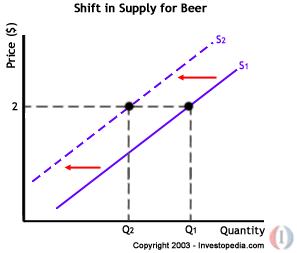 1.) own price (Qs) = move along the supply curve
2.) something else = supply curve shifts
- What shifts supply curve?...
* change in factor prices
* technology changes
* substitutes
* expectations
Supply elasticities
n = (% change in Qs)/(% change in price)
> 1 elastic
< 1 inelastic
What you can read off curve:
(1) marginal opp. cost
(2) total costs
(3) total revenues
(4) producer surplus
"Law" of supply = when the price goes up, the quantity supplied goes up (i.e it costs more to make more)
- quantity supplied = how much you want to produce at any particular price
SUPPLY SCHEDULE
|
Price/M.O.C. (marginal opportunity cost)
|
Quantity Supplied
|
|
$0
|
0
|
|
$0.50
|
0
|
|
$1.00
|
1
|
|
$1.50
|
2
|
|
$2.00
|
3
|
|
$2.50
|
4
|
|
$3.00
|
5
|
- price goes up --> willing to make more
What changes supply?
1.) own price (Qs) = move along the supply curve2.) something else = supply curve shifts
- What shifts supply curve?...
* change in factor prices
* technology changes
* substitutes
* expectations
Supply elasticities
n = (% change in Qs)/(% change in price)
> 1 elastic
< 1 inelastic
What you can read off curve:
(1) marginal opp. cost
(2) total costs
(3) total revenues
(4) producer surplus
Saturday, November 12, 2011
Class Lecture #30 - 11/11
Elasticity and Total Revenues
Total Revenues = P * Q
- when price goes up, Q goes down
- when price goes down, Q goes up
- Example: P goes from $50 - $80 and Q goes from 10 - 4..... is it elastic?
* TRA = $50 x 10 = $500
* TRB = $80 x 4 = $320 ...... decrease in total revenue = price change and TR change in opposite directions = ELASTIC
Income Elasticity of Demand
- (% change in Q)/(% change in income) ......
* > 0 = normal good
* < 0 = inferior good
We also began very preliminary discussions on the law of supply....
Total Revenues = P * Q
- when price goes up, Q goes down
- when price goes down, Q goes up
- Example: P goes from $50 - $80 and Q goes from 10 - 4..... is it elastic?
* TRA = $50 x 10 = $500
* TRB = $80 x 4 = $320 ...... decrease in total revenue = price change and TR change in opposite directions = ELASTIC
Income Elasticity of Demand
- (% change in Q)/(% change in income) ......
* > 0 = normal good
* < 0 = inferior good
We also began very preliminary discussions on the law of supply....
Class Lecture #29 - 11/9
Elasticity (sensitivity: how responsive we are to changes)
n = (% change in Quantity Demanded)/(% change in own price)
- What impacts n?
(1) Time (2) Budgets (3) Substitutes
1) Time: long run = elasticity higher, short run = elasticity lower
2) Budget: higher elasticity for things that make up a great % of budget
3) Substitutes: higher elasticity if more substitutes
n = (% change in Quantity Demanded)/(% change in own price)
- What impacts n?
(1) Time (2) Budgets (3) Substitutes
If n is: | Demand at that point is: | “Picture” | “Words” | Total Revenue Changes |
>1 | “elastic” | flat | sensitive | ΔTR moves in opp. Direction than ΔP |
= 1 | Unit elastic | X | X | X |
<1 | “inelastic” | steep | Not very sensitive | ΔTR same as ΔP |
1) Time: long run = elasticity higher, short run = elasticity lower
2) Budget: higher elasticity for things that make up a great % of budget
3) Substitutes: higher elasticity if more substitutes
Class Lecture #28 - 11/7
This lecture focused on demand curves and how they can shift to the left and right and how you can move up and down along a curve (quantity demand).
Demand: willingness and ability to consume
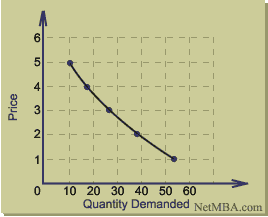
MARKET Demand
- As the prices decrease, the quantity demand increases and vice versa
= movement along curve
- The shape of a demand curve is different for every individual
- Is it possible to aggregate multiple curves into one super curve?
--> curve gets flatter as we aggregate further
--> hard to aggregate beyond a single good
Comparative Statics.... What changes people's consumption of a good?
- own price
- everything else:
1. Income 2. Substitutes 3. Expectations 4. Tastes 5. # of individuals
(income and substitutes = ability, expectations, tastes, # = willingness)
 Income (NOT PRICES!)
- Normal goods = income goes up, quantity demand goes up
- Inferior goods = income goes up, quantity demand goes down
preferences subjective for everyone
Prices of Other Goods
- Substitutes: Q moves in same direction as price change
- Complements: Q moves in opposite direction as price change
Demand: willingness and ability to consume
MARKET Demand
- As the prices decrease, the quantity demand increases and vice versa
= movement along curve
- The shape of a demand curve is different for every individual
- Is it possible to aggregate multiple curves into one super curve?
--> curve gets flatter as we aggregate further
--> hard to aggregate beyond a single good
Comparative Statics.... What changes people's consumption of a good?
- own price
- everything else:
1. Income 2. Substitutes 3. Expectations 4. Tastes 5. # of individuals
(income and substitutes = ability, expectations, tastes, # = willingness)
Income (NOT PRICES!)- Normal goods = income goes up, quantity demand goes up
- Inferior goods = income goes up, quantity demand goes down
preferences subjective for everyone
Prices of Other Goods
- Substitutes: Q moves in same direction as price change
- Complements: Q moves in opposite direction as price change
Sunday, November 6, 2011
Reading Analysis 11/6
A.) I thought it was interesting that everything in the economy as described by the author arose because of their "immediate needs and circumstances" (p. 190). Basically, everything came about because of a need in that particular sector. Even more amazing is the fact that no one orchestrated this movement towards the desired goal; it just came about as one would expect from a typical market. For example, prices for everything experienced inflation whenever more rations (of cigarettes) were delivered to the inmates. This excess in cigarettes caused the prices to rise substantially. But as a lot of these cigarettes began to disappear for non-monetary reasons, i.e. people who needed to smoke, prices experienced steady declines until the next truckload came in. It was clear that machine-made cigarettes were subject to this rising and falling of prices if used as currency, so a new currency was perhaps in the making. This coupled with the formation of a new restaurant introduced a new currency called the Bully Mark. But later when the camp was bombed, the value of cigarettes and food sharply increased, and thus the relative value of the BMk decreased. The cycle continues as more external disruptions are introduced and the economy adjusts accordingly. For this reason, we can say that the economy that arose in a POW camp is, at least in this way, the same as today's markets/economy.
B.) What makes the cigarette the most effective means of exchange in the camp?
What sorts of supplies did inmates have access to prior to the formation of the economy and how did their values change as a result of disruption?
How long did it take for the prices of certain items like bread to settle and how often did they fluctuate?
C.) This article was assigned to demonstrate the effects of the market system, even when no markets exist. It also demonstrates the effects of supply and demand and inflation on the price system.
B.) What makes the cigarette the most effective means of exchange in the camp?
What sorts of supplies did inmates have access to prior to the formation of the economy and how did their values change as a result of disruption?
How long did it take for the prices of certain items like bread to settle and how often did they fluctuate?
C.) This article was assigned to demonstrate the effects of the market system, even when no markets exist. It also demonstrates the effects of supply and demand and inflation on the price system.
EWOT Goggles - 11/6
This week in recitation, we talked about the illegitimacy of today's kidney transplant system and we identified poor trade techniques that directly contribute to this problem. For example, meddlesome preferences disallow any "underground" kidney exchanges to become standard protocol because of the so-called moral issues that are associated with it. Apparently people think it's wrong for fair and necessary exchanges to happen without the watchful eye from the government, even though if these same exchanges were made under today's system, they would be MUCH less efficient. So why doesn't this policy change? Why do people who are desperate for a new kidney have to wait years before they can actually get one when they can do the same thing faster and at a lower price when done "underground"? If we can buy food and other necessities today through markets, why can't we purchase a vital organ that will do the most important thing of all: sustain life (The Unbroken Window)?
Saturday, November 5, 2011
Class Lecture #27 - 11/4
Today's lecture was an introduction to supply and demand and we specifically talked about transaction costs and markets.
Transaction cost - cost of arranging and negotiating contracts and agreements. Three different types:
- "physical" = usually distance
- "ignorance" = not knowing other purchasing opportunities elsewhere
- Interference
A middleman's job is to get buyers and sellers together while also limiting as much as possible the transaction costs. They get a bad wrap because they don't actually produce anything, they just organize a transaction (sometimes poorly). Wegmans is a good example of a middle man because it reduces physical trans. costs by putting everything you need in one place, amongst other reasons.
Prices.... inform buyers and sellers on the value of something as well as its scarcity.
- MARKETS set prices
- many types of markets (goods, factor, etc.) and everything that applies to one market can apply to all other markets
Market - any collection of buyers and sellers (actual or potential).
- MARKETS --> prices emerge --> produce order.... what types of prices?
1. monetary 2. non-monetary 3. monetary AND non-monetary
Buyers = "Demanders" Sellers = "Suppliers"
- Goods - households - Goods - firms
- Factor - firms - Factor - households
Transaction cost - cost of arranging and negotiating contracts and agreements. Three different types:
- "physical" = usually distance
- "ignorance" = not knowing other purchasing opportunities elsewhere
- Interference
A middleman's job is to get buyers and sellers together while also limiting as much as possible the transaction costs. They get a bad wrap because they don't actually produce anything, they just organize a transaction (sometimes poorly). Wegmans is a good example of a middle man because it reduces physical trans. costs by putting everything you need in one place, amongst other reasons.
Prices.... inform buyers and sellers on the value of something as well as its scarcity.
- MARKETS set prices
- many types of markets (goods, factor, etc.) and everything that applies to one market can apply to all other markets
Market - any collection of buyers and sellers (actual or potential).
- MARKETS --> prices emerge --> produce order.... what types of prices?
1. monetary 2. non-monetary 3. monetary AND non-monetary
Buyers = "Demanders" Sellers = "Suppliers"
- Goods - households - Goods - firms
- Factor - firms - Factor - households
Thursday, November 3, 2011
Class Lecture #26 - 11/2
What happens to U.S. dollars when we trade with China? They have 4 options to choose from:
1. Send that money back by purchasing American goods
2. Invest in the American stock market (buy assets) because it's harder to do so in China. Our stock market is a very attractive option for foreigners based on the fact that our capital account balance has seen a surplus every year
3. Buy from a country other than the U.S. (either products or assets). Eventually, this money will make it's way back to the U.S.
4. Eat the $$ - What seems to be the most absurd option would actually help the U.S. the most because it would raise the value of the dollar and make everyone richer.
Even though we have a trade deficit from our current account balance, our capital account balance balances it all out and we end up having a net balance of zero (we always have to have an international trade balance of zero because of the 4 options described above).
None of these options hurt the U.S. In fact, they all help us, so how can one argue that trade with China is bad? There is NO EVIDENCE that trade with China and the trade deficit are bad.
1. Send that money back by purchasing American goods
2. Invest in the American stock market (buy assets) because it's harder to do so in China. Our stock market is a very attractive option for foreigners based on the fact that our capital account balance has seen a surplus every year
3. Buy from a country other than the U.S. (either products or assets). Eventually, this money will make it's way back to the U.S.
4. Eat the $$ - What seems to be the most absurd option would actually help the U.S. the most because it would raise the value of the dollar and make everyone richer.
Even though we have a trade deficit from our current account balance, our capital account balance balances it all out and we end up having a net balance of zero (we always have to have an international trade balance of zero because of the 4 options described above).
None of these options hurt the U.S. In fact, they all help us, so how can one argue that trade with China is bad? There is NO EVIDENCE that trade with China and the trade deficit are bad.
Subscribe to:
Comments (Atom)